TL;DR: A 12 October 2026 registry study of 200 operators found two-handed buddy-aid applications were faster and more often successful than one-handed self-aid applications in simulation, while a clinical protocol details the slack removal, tightening, and lock-down steps that define a complete application.
Two pathways produced different times and success records
The finding comes from a research article published 12 October 2026 in BMC Emergency Medicine, available through Springer Nature Link, which compared operational training pathways for windlass tourniquets.
According to BMC Emergency Medicine, the authors framed rapid control of life-threatening extremity hemorrhage as central to tactical and civilian prehospital care and set out to compare timing and recorded simulated hemorrhage-control success between one-handed self-aid/restricted-hand and two-handed buddy-aid/responder-assisted pathways while characterizing technical-error patterns.
The design was a retrospective training-registry study of 200 unique operators assessed from 15 January 2024 to 19 December 2025, with 98 one-handed records and 102 two-handed records, according to BMC Emergency Medicine. Primary outcomes were total application time and recorded simulated hemorrhage-control success, with unadjusted effects reported with 95% confidence intervals.
Adjusted timing used median quantile regression and binary success used Firth penalized logistic regression, according to BMC Emergency Medicine. An objective-only sensitivity analysis excluded legacy checkbox-only records, leaving 184 records with objective fields.
The two-handed pathway was 8.5 seconds faster at the median
Median total application time was 51.0 seconds for the one-handed pathway and 42.5 seconds for the two-handed pathway, according to BMC Emergency Medicine.
The median difference was minus 8.5 seconds, with a 95% bootstrap confidence interval from minus 13.0 to minus 5.5 seconds and p less than 0.001, according to BMC Emergency Medicine.
After adjustment, the median difference was minus 9.0 seconds, with a 95% confidence interval from minus 11.6 to minus 6.3 seconds and p less than 0.001, according to BMC Emergency Medicine.
The median comparison describes total application time recorded in the registry, not a clinical bleeding outcome, according to BMC Emergency Medicine. The primary timing result was paired with a separate success outcome rather than combined into a single score.
Measurement quality was addressed through the objective-only sensitivity analysis, which separated records with objective fields from legacy checkbox-only records, according to BMC Emergency Medicine.
Success rates differed by 10.4 percentage points overall
Recorded simulated hemorrhage-control success was 82 of 98, or 83.7%, for the one-handed pathway and 96 of 102, or 94.1%, for the two-handed pathway, according to BMC Emergency Medicine.
The risk difference was 10.4 percentage points, with a 95% confidence interval from 1.7 to 19.6 percentage points and p equal to 0.018, according to BMC Emergency Medicine.
In the 184 records with objective fields, success was 75 of 90, or 83.3%, versus 90 of 94, or 95.7%, a risk difference of 12.4 percentage points with a 95% confidence interval from 3.6 to 21.8, according to BMC Emergency Medicine.
Firth regression estimated higher odds of recorded success with the two-handed pathway, with an adjusted odds ratio of 4.75, a 95% profile-likelihood confidence interval from 1.59 to 16.64, and p equal to 0.004, according to BMC Emergency Medicine.
With additional adjustment for sex, glove use, and limb location, the estimate was an odds ratio of 5.03, with a 95% profile-likelihood confidence interval from 1.65 to 18.37 and p equal to 0.004, according to BMC Emergency Medicine.
Errors centered on rod securing and second-device use
Incomplete rod securing and second-tourniquet use showed the clearest between-pathway technical-error differences, according to BMC Emergency Medicine.
The study objective included characterizing actionable technical-error patterns rather than reporting speed alone, according to BMC Emergency Medicine.
Its background noted that training studies often emphasize speed without separating technical errors and measurement quality, according to BMC Emergency Medicine.
The authors concluded that the two-handed buddy-aid/responder-assisted pathway was associated with faster application and higher recorded simulated hemorrhage-control success than the one-handed self-aid/restricted-hand pathway, according to BMC Emergency Medicine.
They reported that the association remained similar after additional adjustment for sex, glove use, and limb location, according to BMC Emergency Medicine.
They also stated that pathway classification incorporated assistance context and other operational circumstances in addition to the number of hands used, according to BMC Emergency Medicine. The findings were presented as supporting pathway-specific training and competency assessment rather than a causal conclusion that two-handed application is mechanically or clinically superior.
Correct application requires slack removal, full tightening, and lock-down
A separate clinical protocol published 9 October 2026 as How to Apply a Windlass Tourniquet: Clinical Protocol - MED-TAC defines three mechanical essentials for definitive arterial occlusion.
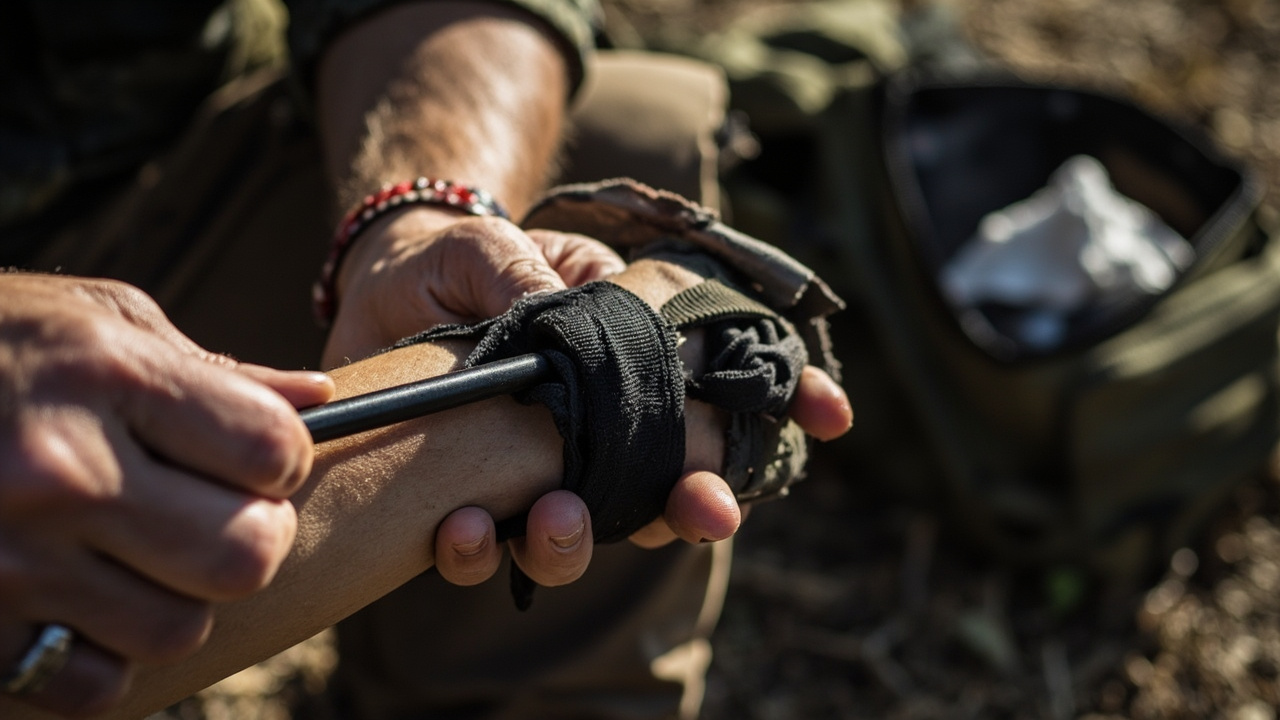
According to the MED-TAC clinical protocol, those essentials are eliminating all band slack before rotating the windlass, turning the rod until bright arterial bleeding and distal pulse stop completely, typically in 2 to 3 turns, and locking the windlass in the clip with the time documented.
For slack elimination, the protocol states the band must be so tight before windlass rotation that fewer than three fingertips fit under the strap, according to the MED-TAC clinical protocol.
For the occlusion endpoint, the protocol directs rotation until distal pulse is completely abolished, with intense pain expected and no loosening to relieve discomfort, according to the MED-TAC clinical protocol.
The protocol identifies slack as the primary failure mode and states that leaving slack in the band or stopping tightening prematurely frequently results in continued blood loss, according to the MED-TAC clinical protocol.
For large or muscular thighs with persistent bleeding after maximal rod rotation, the protocol directs immediate application of a second tourniquet directly touching the first, according to the MED-TAC clinical protocol.
The protocol also states that severe extremity hemorrhage can cause fatal hemorrhagic shock in under three minutes and describes a windlass tourniquet as the single most effective tool to stop arterial blood loss before definitive surgical care, according to the MED-TAC clinical protocol.
Placement depends on threat level and wound visibility
The MED-TAC clinical protocol defines high-and-tight placement for Care Under Fire or immediate active threat and 2-to-3-inches-proximal placement for Tactical Field Care or a controlled setting.
In the high-and-tight method, the band goes as high as possible on the limb toward the axilla or groin and may be applied directly over uniform fabric after clearing pockets, according to the MED-TAC clinical protocol.
In the controlled-setting method, the band goes 2 to 3 inches directly above the highest bleeding site and is applied directly onto exposed skin after cutting away clothing to inspect the wound, according to the MED-TAC clinical protocol.
The stated rationale for high placement is that multiple or hidden wounds cannot be ruled out under threat or in darkness, while the stated rationale for the measured proximal placement is preservation of viable tissue and joint function while achieving complete arterial occlusion, according to the MED-TAC clinical protocol.
A critical anatomical rule in the protocol prohibits application directly over a joint, stating that bone structures within the elbow or knee shield deep vessels and prevent circumferential compression, according to the MED-TAC clinical protocol.
The protocol directs positioning the band either 2 to 3 inches above the joint or on the limb section proximal to it, and prohibits placement over holsters, pocket knives, or heavy cargo pocket contents, according to the MED-TAC clinical protocol.
The tested skill maps to a widely carried windlass device
The Combat Application Tourniquet, or C-A-T, is a windlass tourniquet made by North American Rescue for stopping life-threatening bleeding from an arm or leg, according to the Combat Defender CAT Tourniquet Guide published 6 October 2026.
The current version is the Gen 7 with a single routing buckle that can be applied with one hand, and it is on the list of tourniquets recommended by the U.S. military's Committee on Tactical Combat Casualty Care, according to the Combat Defender CAT Tourniquet Guide.
North American Rescue is cited as identifying the C-A-T as the official tourniquet of the U.S. Army since 2005, with band width of 1.5 inches, about 38 millimeters, and weight of 2.7 ounces, about 77 grams, according to the Combat Defender CAT Tourniquet Guide.
The Gen 7 components named in the guide are a self-adhering band with a red tip, a single routing buckle with one slot, an internal free-moving band, a thicker ribbed windlass rod, a C-shaped windlass clip workable from either side, and a gray windlass strap with a write-on time label, according to the Combat Defender CAT Tourniquet Guide.
The guide lists black for duty, orange for public access, and blue for trainer, and states one use only on a real casualty with training performed using a trainer, according to the Combat Defender CAT Tourniquet Guide.
The authors state that every fact about the C-A-T comes from North American Rescue, the U.S. Army, or the CoTCCC, with application steps from the TCCC skill sheet and Stop the Bleed, according to the Combat Defender CAT Tourniquet Guide.
What the registry result means for a bug-out loadout
The registry data support packing for both self-aid and buddy-aid scenarios because the two pathways had different times, success records, and error patterns, according to BMC Emergency Medicine.
Because incomplete rod securing distinguished the pathways, the MED-TAC sequence for locking the windlass rod inside the bilateral clip, routing the remaining band over the rod and through the clip, and securing the hook-and-loop Time Strap across both brackets is directly relevant to kit practice, according to the MED-TAC clinical protocol.
Because second-tourniquet use also distinguished the pathways, the protocol direction to carry capacity for a second device for large or muscular thighs after maximal rotation has a direct packing implication, according to the MED-TAC clinical protocol.
Because the C-A-T Gen 7 uses a single routing buckle intended for one-hand application and is available in duty, public-access, and trainer colors, a loadout can separate a sealed carry device from a blue practice device, according to the Combat Defender CAT Tourniquet Guide.
The guide advises carrying the device where either hand can reach it and practicing with a blue trainer rather than the carried device, according to the Combat Defender CAT Tourniquet Guide.
Recording the exact time requires a permanent marker for writing on the Time Strap, using a format such as T equals 14:35, without concealing the applied device, according to the MED-TAC clinical protocol.
The registry study was supported by the 2025 Military Special Research Project of the 986th Hospital of the Air Force, number 986YYJS2025-01, and the 2023 Clinical Research Project of Air Force Military Medical University, number 2023LC2332, according to BMC Emergency Medicine. Co-first authors were Na Xu and Xiaorui Wang, with correspondence to Lin Ai and Jing Feng, according to BMC Emergency Medicine.
Sources referenced
- BMC Emergency Medicine | Springer Nature Link – Timeliness, simulated hemorrhage-control success, and technical errors (12 Oct 2026) (https://link.springer.com/article/10.1186/s12873-026-01799-y)
- How to Apply a Windlass Tourniquet: Clinical Protocol - MED-TAC (9 Oct 2026) (https://tactical-medicine.com/blogs/news/how-to-apply-a-windlass-tourniquet-placement-tightening-and-common-errors)