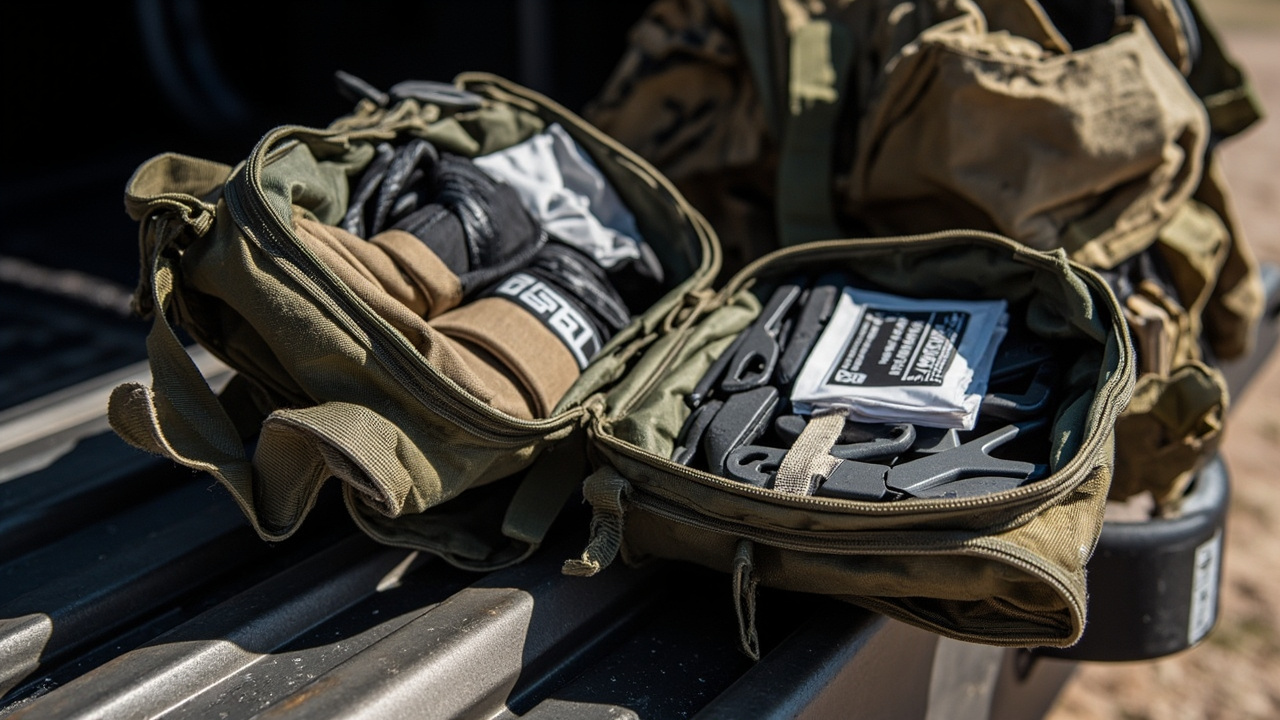
TL;DR: Two August 2026 hands-on comparisons of eight trauma kits each and a separate counterfeit-gear review agree on one loadout rule: pack a genuine tourniquet you can reach in seconds, then add hemostatic gauze and a chest seal.
Why this test week matters for bug-out bags
Two independent test teams published eight-kit comparisons within days in August 2026, and both ranked kits on tourniquet authenticity and speed of access.
According to 8 Best Trauma First Aid Kits (October 2026) Tested & Reviewed from ACFC, a reviewer with more than a decade carrying kits as an EMT found the gap between a good kit and a life-saving kit came down to whether the tourniquet was genuine and whether the bag opened fast enough under stress. According to 8 Best Trauma First Aid Kits (October 2026) Tested & Reviewed from Cleve Land Heart, a second reviewer spent three months packing eight kits into range bags, glove boxes and backpacks and running timed drills with weighted dummies.
Both teams defined the category the same way. A standard first aid kit handles cuts, scrapes, splinters and blisters. A trauma kit, also called an IFAK or Individual First Aid Kit, is built for massive hemorrhage, tension pneumothorax and airway compromise, using tools including a CAT Gen 7 tourniquet, hemostatic gauze and chest seals.
That definition shapes a practical loadout. Cleve Land Heart's testing noted severe bleeding remains the leading preventable cause of death after traumatic injury, and cited the Hartford Consensus that bystander tourniquet use or wound packing in the first three to five minutes can shift survival odds dramatically.
Counterfeit warning behind the rankings
A third origin, the MED-TAC investigation titled Fake Israeli Bandages & Counterfeit Hemostatic Gauze, published August 24, 2026, examined why authenticity dominated both kit tests.
The investigation summarized a 2023 bench study led by Emanuele Lagazzi. Certified Stop the Bleed instructors applied 50 uncertified look-alike tourniquets bought from Amazon and AliExpress and 25 genuine Combat Application Tourniquets to a medical-grade manikin leg instrumented with eight force sensors, using three windlass turns each under laboratory conditions.
Mean price was $27.19 for the genuine device and $6.07 for the look-alike. Mean force at application was 65 N for the genuine CAT and 14 N for the look-alike. Force at one hour was 67 N versus 14 N. Mechanical rupture during placement was 0% versus 4%. Mean strap length was 94.5 cm versus 90.1 cm. The difference in force held at P<.001.
MED-TAC reported the published consequence of that failure mode is increased blood loss, limb edema and compartment syndrome, because a device that occludes outflow while arterial inflow continues acts as a venous constricting band. Two of the 50 look-alikes snapped during placement by an instructor on a mannequin.
The same investigation graded Lagazzi 2023 as a bench study on an instrumented manikin, not perfused tissue and not a human trial, with authors calling for perfused-model replication. It described the finding as usable because of direction and magnitude, characterizing a 4.6-fold force deficit under ideal conditions.
What the eight-kit field tests selected
ACFC's comparison narrowed eight popular kits to a top three for October 2026. The Editor's Choice was the EVERLIT Emergency Trauma Kit with CAT GEN-7 tourniquet, 36 inch splint, MOLLE pouch and TCCC alignment. The Premium Pick was the North American Rescue Bleeding Control Kit with genuine U.S.-made CAT, public-access design and compact 15 oz weight. The Best Value was the THRIAID Survival First Aid Kit with 60-plus items, chest seal included and 1200D nylon.
Cleve Land Heart's quick overview listed a different eight-kit field: 1STHOUR Trauma First Aid Kit with 82 pieces, tourniquet and chest seal and compact pouch; SUPOLOGY Premium IFAK Kit with 115 pieces, 36 inch splint and Israeli bandage; EVERLIT Advanced Trauma Kit with CAT GEN-7, TCCC alignment, Israeli dressing and chest seal; Pasenhome Rapid-Response Kit with 20 labeled compartments, waterproof construction and MOLLE straps; Adventure Medical Kits Trauma Pak with QuikClot sponge, trauma pad and waterproof packaging; Lightning X Extra Large Medic Bag with 250-plus items, responder grade and MOLLE customization; Qirexynor 250 Piece Survival Kit with 250 pieces, hemostatic gauze and SAM splint; and RHINO RESCUE IFAK Trauma Kit Pro with genuine CAT tourniquet, rip-away panel and car headrest mounting.
The overlap is instructive for evacuation packing. Both lineups include EVERLIT, SUPOLOGY, RHINO RESCUE and Adventure Medical Kits options. Both include a compact public-access style North American Rescue bleeding-control option alongside larger responder bags. Neither lineup treats adhesive bandages as trauma coverage.
EVERLIT, North American Rescue and THRIAID in detail
ACFC reported the EVERLIT Emergency Trauma Kit weighed 1.8 pounds and paired a military-grade CAT GEN-7 tourniquet with a 36-inch aluminum splint, MOLLE-compatible pouch, compressed gauze, Israeli-style pressure dressing and thermal blanket for shock. The tourniquet rode on top for one-handed access, with gauze and bandages behind it and the splint folded flat at the bottom.
The same test found the base configuration did not include HyFin chest seals, requiring a separate add for penetrating chest trauma. It also found the bag layout took practice to access quickly, while pull tabs were findable by feel in low-light training. The kit was described as designed by U.S. military veterans, with the CAT sourced from authorized distributors, and the reviewer noted counterfeit tourniquets were a real problem on Amazon. EVERLIT was described as operating since 2018 with input from former military medics.
ACFC reported more than 5,300 reviews averaging 4.8 stars for that EVERLIT kit, HSA and FSA eligibility through most providers, and a 1-year warranty from EVERLIT. The reviewer reported carrying the same EVERLIT kit for about four years for range days and using the splint during two suspected fractures on outdoor trips.
The North American Rescue pick was listed at 15 oz with a genuine U.S.-made CAT and public-access design. The THRIAID value pick was listed with more than 60 items, an Israeli bandage and chest seal in 1200D nylon.
For a bug-out bag, that combination maps to three roles. EVERLIT covers belt, plate-carrier or vehicle-seat carry. North American Rescue covers a compact public-access pouch. THRIAID covers a budget home, car or range-bag kit that still includes a chest seal.
Budget and bulk options for vehicles and worksites
Cleve Land Heart's testing detailed the 1STHOUR Trauma First Aid Kit as an 82-piece kit priced under $50, at one point around $49, in a 6 x 5.5 x 7.75 inch pouch. Contents included a tourniquet, Israeli-style pressure bandage, chest seal, compressed gauze and trauma shears, with elastic loops, a low-profile MOLLE back panel, top carry handle and D-ring.
The reviewer asked a friend with zero medical training to find the tourniquet, and the friend located it in under four seconds because of color-coded loops. The shears cut through denim during the test. Shipping was not Prime, so the review advised planning ahead for a trip. The kit included only plain compressed gauze, not hemostatic gauze such as QuikClot, and the review suggested adding a QuikClot pack separately for faster clotting. The brand was described as having a limited track record compared with North American Rescue.
SUPOLOGY's 115-piece kit was counted piece by piece in that test, with the count described as honest. It included a 36 inch SAM-style splint, described as rare in that price range, in a 1.28 pound Oxford bag, with third-party inspection and certification plus burn gel and burn pad. Stock was listed as only one left at the time of review, and the brand was described as new to the trauma market.
ACFC listed the Scherber First Responder Fully-Stocked EMT and EMS Trauma Kit with more than 200 supplies, eight zippered pockets, reflective striping, Star of Life embroidered logo, detachable padded shoulder strap and 7-pound weight. That weight and bulk place it as a vehicle or worksite station rather than a belt IFAK.
Loadout consequence: audit before you add bulk
The investigations point to a sequence for shelter and evacuation packing. Verify the tourniquet first, then confirm rapid opening, then fill remaining space.
MED-TAC's history section said the Emergency Bandage was invented by Israeli combat medic Bernard Bar-Natan, produced by First Care Products, later sold to PerSys Medical in Houston and now manufactured under Safeguard Medical in the same Israeli factory at roughly 1.5 to 2 million units per year, with FDA clearance as a non-pneumatic tourniquet. It said Israeli bandage itself is a colloquialism with no agency owner and no standards-body definition.
The engineering note matters for inspection. MED-TAC reported the real device uses a rigid pressure applicator bar, where the elastic leader wraps around the bar and reverses direction to convert distributed wrap into focused compression over the bleeding source. It reported cheap versions flex, pull out of seating, lose elastic recoil after one wrap, fail to hold at the closure bar and may lack validated sterile packaging.
MED-TAC also cited an April 2022 incident in eastern Ukraine in which a 19-year-old soldier lost both legs below the knee after stepping on an antipersonnel mine. Responders applied bilateral CAT-style tourniquets. The windlass on the right-side device broke in transit, brisk hemorrhage restarted, and the patient died of hemorrhagic shock before arrival at an urban trauma center. The investigation identified that account as a 2024 peer-reviewed case report and attributed failure to the device being counterfeit rather than to responder training.
For evacuees deciding what supplies may go to shelters, the practical takeaway from the reporting is documentation and compatibility. Keep a compact IFAK with a verifiable CAT, Israeli-style dressing, compressed or hemostatic gauze, chest seal, shears, gloves and blanket in the go-bag. Keep a larger 200-plus-item responder bag or 250-piece survival kit in the vehicle where 7-pound weight is manageable. Keep a 1.76 oz ultra-compact option such as the Adventure Medical Kits Trauma Pak with QuikClot gauze where space is limited to a glove box or small daypack.