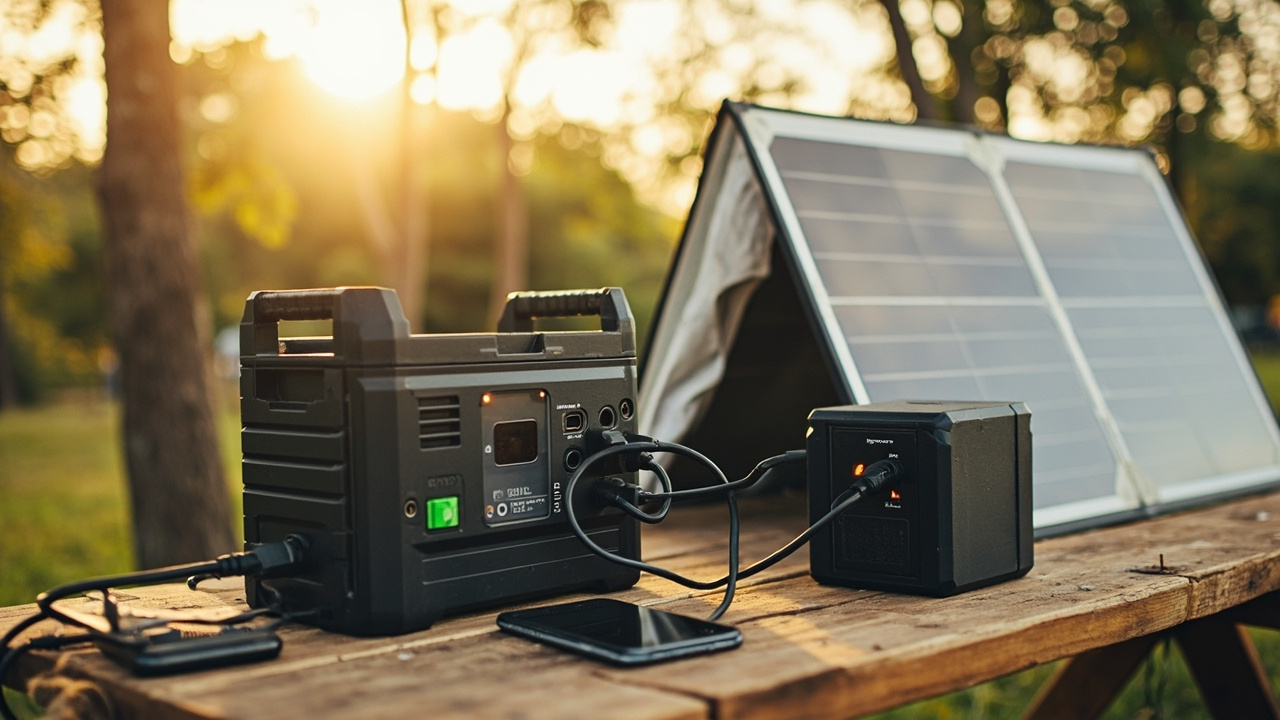
TL;DR: Two independent October 2026 lab tests name the EcoFlow Delta 3 Plus (1,024 Wh, 1,800-2,400 W class) as the best all-round portable power pack, while long-run field testing names the Jackery Explorer 1000 v2 (1,070 Wh, 1,500 W, 23.8 lb) as the best carry-weight pick for evacuation kits.
Two fresh tests, one answer for bug-out power
TechRadar updated its portable power station ranking on October 13, 2026, after putting more than 50 units through lab and field checks for blackouts, camping and off-grid work, according to TechRadar Best portable power stations of 2026. IMTEST published a separate laboratory comparison on October 5, 2026, by Lotta Kinitz and Julia Struck that measured usable capacity, charge time, noise and ports from compact units to 6,000-watt systems, according to IMTEST Strom zum Mitnehmen: Powerstations im Härtetest.
Both programs reached the same headline result. TechRadar lists the EcoFlow Delta 3 Plus as No. 1 overall for most users, citing 1,024 Wh capacity, 2,400 W output, four AC outlets, two USB-C, two USB-A, one car outlet and two DC5521 ports, 1,000 W solar input and a 10-millisecond UPS switchover. IMTEST calls the same EcoFlow Delta 3 Plus its test winner, citing the same 1,024 Wh rating, four outlets to 1,800 W continuous, two USB-A, two USB-C, 1,000 W solar in the Plus version and a 51-minute AC full charge measured in the lab.
A third independent program adds carry-weight context. SmashingRobotics published testing on September 23, 2026, by Ryan Mitchell after three months running fridges, CPAP machines, Starlink terminals, drones and robot platforms through ten stations, according to SmashingRobotics 10 Best Portable Power Stations (October 2026) Tested & Ranked. That program names the Jackery Explorer 1000 v2 as best overall for most people, citing a 1,070 Wh LiFePO4 cell, 1,500 W continuous output, 3,000 W surge, 23.8-lb foldable frame, fast 1.7-hour full charge and 4,000-cycle rating to 70 percent.
What the No. 1 pack actually delivered in testing
TechRadar reports testing the Delta 3 Plus in a home office, garden, Jeep and on the road, with quiet operation, rapid charging and robust build quality. The same program reports simulating several power outages in which a router, laptop and lights stayed on for as long as the station held charge, linked to the 10-millisecond UPS switchover.
IMTEST reports 825 Wh of usable energy from the 1,024 Wh Delta 3 Plus rating when running 80-watt fans for 10 hours 19 minutes, a gap of 19.4 percent that the lab describes as within the acceptable range. The same lab reports the Plus accepts 1,000 W of solar through two XT60 inputs at up to 500 W per input, double the 500 W accepted by the base Delta 3. IMTEST lists the unit at 12.5 kilograms with two carry handles and balanced weight distribution for short carries, and lists the recommended price at 849 euros.
IMTEST adds that only the AC cable is included, while solar cables and a car-charging cable for the 12-volt socket cost extra. The lab notes four 230-volt outlets to 1,800 W continuous and short-term tolerance to 3,600 W, two 100-watt USB-C ports, two 18-watt USB-A ports, one 126-watt car socket and two DC barrel outputs. The lab reports an espresso from a 1,400-watt Tchibo Esperto Mini caused no problems, but notes the unit does not run multi-day electric cooking, a space heater beyond about two hours, or a full e-bike recharge without using more than half its capacity.
What the lightest 1-kWh pack proved over three months
SmashingRobotics reports keeping a Jackery Explorer 1000 v2 on a kitchen counter for the full test window, charging every other day, running a 50-watt mini-fridge overnight and powering a woodworking router through three pure sine-wave AC outlets without tripping or overheating. The same program reports running a home network with router, fiber ONT and 27-inch monitor for 14 hours to 20 percent remaining during a planned outage.
The same tester reports 3 to 4 nights for CPAP on a heated-tube setting, matching Amazon reviewer reports cited in the test, and reports charging a MacBook Pro from 10 to 80 percent in under an hour through the 100-watt PD USB-C port. The program confirms emergency charging to full in about one hour through the app, and recommends using that mode sparingly because faster cycling adds cell wear. The program lists standard full-charge time at about 1.7 hours, notes the solar panel is sold separately, and notes minor heat on the DC car cable reported by some users on long drives.
PowerStationGearLab updated a three-way 1-kWh comparison on October 18, 2026, using maker spec sheets for the Jackery Explorer 1000 v2, EcoFlow Delta 2 and Anker SOLIX C1000, according to PowerStationGearLab Jackery vs EcoFlow vs Anker SOLIX 2026. That table lists the Jackery at 1,070 Wh, 1,500 W continuous and about 23.8 lb, the EcoFlow Delta 2 at 1,024 Wh, 1,800 W with 2,700 W X-Boost and about 27 lb, and the Anker SOLIX C1000 at 1,056 Wh, 1,800 W with 2,400 W surge and about 30 lb. The same comparison lists cycle life at about 4,000 cycles to 80 percent for Jackery and about 3,000 cycles to 80 percent for both rivals, wall recharge at about one hour to 100 percent for Jackery, about 50 minutes to 80 percent for EcoFlow Delta 2, and about 58 minutes to 100 percent for Anker, and solar maxima at about 400 W for Jackery, about 500 W for EcoFlow and 600 W for Anker.
Small packs and big home units set the loadout limits
TechRadar lists the Bluetti Elite 30 V2 as best on a budget, citing 288 Wh, 600 W output with 1,500 W in Lifting Mode, 9.8 x 7 x 6.6-inch size, multiple USB-C and USB-A ports, mobile-app control and quick recharging. The same TechRadar tester reports using that 288 Wh unit during several storm-caused outages to recharge devices and tools on an installation job. SmashingRobotics lists the Anker SOLIX C300 at 288 Wh, 300 W, 9.1 lb and 25 dB, and TechRadar lists the same class as ultra-portable for phones, laptops and short jobs.
IMTEST lists the EcoFlow Delta Pro at 3.2 kWh usable from a 3.6-kWh rating, a 10-percent gap, with 3,600 W output for air conditioners, hot plates and power tools. The same lab lists that unit at 45 kilograms with a rolling-case design for flat ground, under-90-minute AC charging, 1,600-W solar acceptance, four outlets, two USB-A, two USB-C, one car output and app control, at 2,199 euros. TechRadar lists the larger EcoFlow Delta Pro 3 class and Anker Solix F3800 class for home backup and RV use, with the F3800 cited at 136.7 lb and multiple NEMA outlets including TT-30R, L14-30R and six 5-20R.
SmartHomeExplorer updated a home-backup consensus on October 4, 2026, citing OutdoorGearLab measurements of 1,740 Wh usable from the 2,042 Wh Jackery Explorer 2000 v2, 897 Wh from the 1,056 Wh Anker SOLIX C1000, 3,790 Wh from the EcoFlow Delta Pro 3, 910 Wh from the Jackery Explorer 1000 v2 and 890 Wh from the Anker SOLIX C1000 Gen 2, according to SmartHomeExplorer Best Portable Power Stations for Home Backup 2026. The same guide notes the Jackery Explorer 2000 v2 recharges from empty in 2.5 hours on AC, carries a 5-year warranty, uses a DC8020 solar plug missing on many third-party panels, and is capped at 400 W of solar versus 600 W on both Anker models.
What this means for a bug-out bag and vehicle kit
For a vehicle-supported evacuation kit, the test data point to the 1-kWh LiFePO4 class near 23.8 to 27.6 lb. SmashingRobotics identifies the 23.8-lb Jackery Explorer 1000 v2 as the lightest real 1-kWh option tested that still runs a full-size refrigerator for several hours. PowerStationGearLab lists the 23.8-lb Jackery as roughly 9 lb lighter than the 27-lb EcoFlow Delta 2 and about 11 lb lighter than the 30-lb Anker SOLIX C1000.
For apartment and shelter-adjacent use where fuel generators are excluded, TechRadar notes portable stations run quiet with no carbon-monoxide fumes and recharge from solar. IMTEST notes modern LiFePO4 cells are rated as robust and long-lived, while NMC cells are lighter but more sensitive. IMTEST advises buyers to match continuous output to loads, noting a few hundred watts covers phones, speakers and notebooks, while hot plates, espresso machines and hair dryers call for 1,500 to 2,000 W continuous.
For extended outages, the labs favor pairing a 1-kWh station with solar rather than sizing up to a 45-kilogram or 114- to 136-lb home unit for carry. IMTEST lists the Delta 3 Plus solar ceiling at 1,000 W and the Delta Pro ceiling at 1,600 W. SmashingRobotics reports two 400-watt panels broadly breaking even against fridge, internet, lighting and fan loads in daylight field notes cited by How-To Geek field testing in August 2026, and TechRadar notes EcoFlow, Jackery, Bluetti, Anker and DJI all offer panel pairings with different plugs and adapters.
The practical split from the October tests is direct. Put a sub-10-lb 288 Wh unit with USB-C PD in the walk-out bag for phones, laptops, radios and CPAP nights. Keep a 23- to 28-lb 1,024- to 1,070 Wh unit with at least 1,500 W continuous, one 100-watt USB-C port and 400- to 600-W solar input in the vehicle for fridge, router, lighting and cooking. Reserve 3-kWh-plus 3,600-W rolling units for garage backup, because the labs list them at 45 kilograms and higher with roller-only mobility on soft ground.
Sources referenced
- Best portable power stations of 2026: Reliable off-grid power & backup | TechRadar (https://www.techradar.com/best/portable-power-stations)