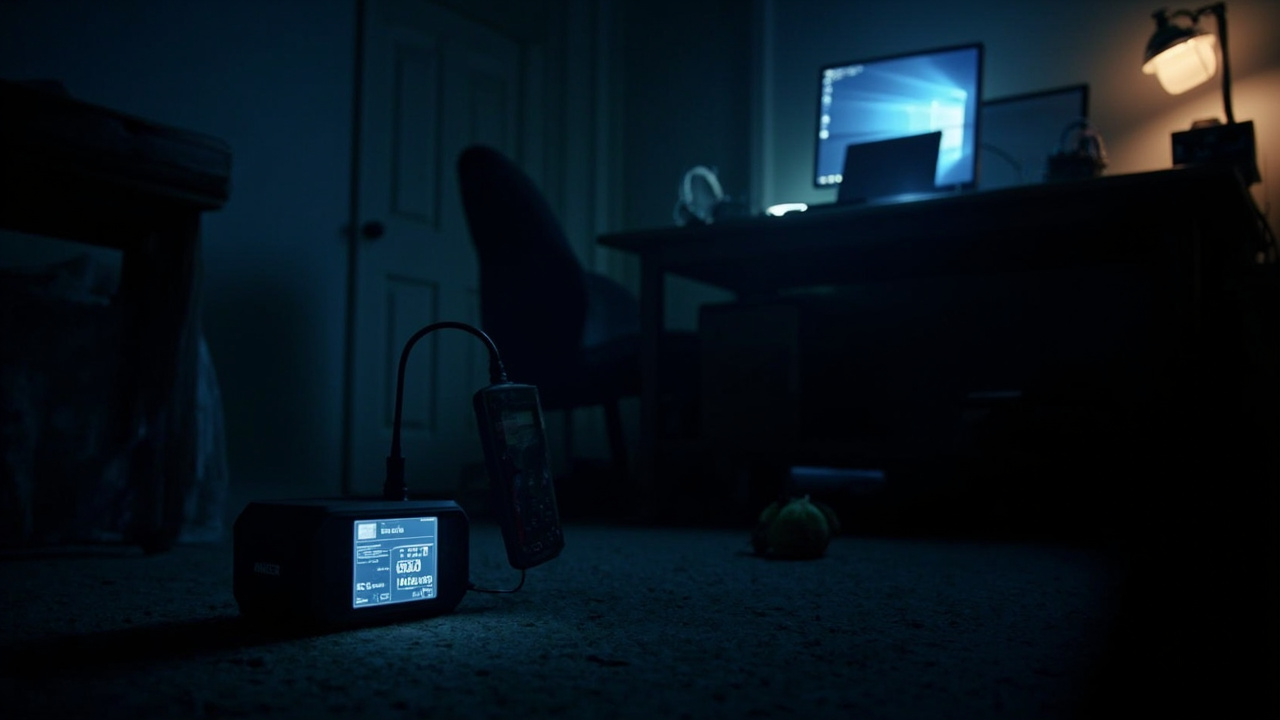
TL;DR: A home-office owner measured an Anker Solix C1000X Gen 1 three times and got 707 to 727 watt-hours of usable AC power, enough for about 11 to 12 hours running a laptop and 24-inch 4K monitor at 60Wh per hour.
What the three runs found
The newest verified finding, reported October 4, 2026, is that usable output stayed in a tight band across three full cycles. According to Anker Solix owner tracks 3 discharge tests, says portable battery still covered a full workday, the three measured totals were 708 watt-hours in one cycle, 727 watt-hours in another, and 707 watt-hours in the third.
The unit in that report is identified as the Anker Solix C1000X Gen 1 with a rated capacity of 1,056 watt-hours. Against that rating, the measured totals represent about 67% to 69% of nominal capacity when running an AC load.
The load in the test was a Windows laptop paired with a 24-inch 4K display. The tester reported average consumption of 60Wh over a one-hour period. At that rate, the measured totals supported roughly 11 to 12 hours of runtime.
The tester described that result as sufficient for the planned backup role. The account quoted in the report states the 11 to 12 hours was plenty for the intended use case.
For bug-out bags and shelter-in-place kits, the headline lesson is direct: plan on usable AC energy, not the printed watt-hour rating. A station rated above 1,000Wh delivered a little more than 700Wh in this particular laptop-and-monitor test case.
How the owner tested it
The procedure was simple and repeatable. According to Anker Solix owner tracks 3 discharge tests, says portable battery still covered a full workday, the tester recharged the battery to 100% before each run.
Each run then powered the workstation from the station until the station shut itself off. Energy was tracked with a consumer-grade watt meter.
The buyer had purchased the unit as backup for the Windows laptop and 24-inch 4K display. That pairing defines the scope of the finding. It does not establish runtime for a refrigerator, heater, CPAP machine, lighting array, or other emergency loads.
Recharging from the wall took about 1,220Wh each time. Using wall input compared with measured AC output, the tester estimated overall charge-and-discharge efficiency at 58% for this test case.
The tester also noted an analytical limit. Technical details including depth of discharge and AC inverter efficiency were not officially published for this power station, so unit self-consumption could not be determined from the collected data alone.
That caution matters for loadout math. Without published depth-of-discharge and inverter figures, owners cannot separate battery reserve, conversion loss, and idle draw from a single wall-to-load number.
Why usable power ran below the label
Many buyers expect the headline battery rating to translate directly into backup time. In practice, power drawn through the AC inverter can produce lower usable output.
That point is central to the October 4 report. It describes the gap between the 1,056Wh rating and the 707 to 727Wh measured through an AC workstation load.
A second independent test source provides broader context for that gap. According to Portable Power Stations: Real Capacity, usable energy is always less than advertised capacity because of inverter losses, battery management, and temperature effects.
That second source, published October 3, 2026, describes testing six models through real loads. The listed loads were laptop charging at 65W USB-C PD, a mini fridge at 60W continuous, an LED light panel at 30W, and a CPAP machine at 45W.
In that six-model comparison, usable shares ranged from 82% to 86%. The report advises readers to expect 82-86% usable capacity and to multiply advertised Wh by 0.85 for realistic expectations.
The Anker model in that comparison was not the same unit as the three-run home-office test. The comparison tested the Anker Solix F2000, rated at 2,400Wh, and recorded 2,016Wh usable, or 84%.
Other results in the same comparison illustrate the range. The Jackery Explorer 2000 Pro, rated at 2,160Wh, delivered 1,836Wh usable, or 85%. The EcoFlow Delta 3, rated at 1,800Wh, delivered 1,548Wh usable, or 86%.
The Bluetti AC200L, rated at 2,304Wh, delivered 1,912Wh usable, or 83%. The Ugreen PowerRoam 1200, rated at 1,024Wh, delivered 870Wh usable, or 85%. The VTOMAN FlashSpeed 1500, rated at 1,408Wh, delivered 1,154Wh usable, or 82%.
The home-office result of about 67% to 69% was therefore lower than the 82% to 86% band reported in the six-model comparison. The difference reflects different units, loads, meters, and AC versus mixed-load methods, not a single merged test.
Cold is another variable identified in the second source. According to Portable Power Stations: Real Capacity, cold temperatures reduce capacity by an additional 10-15%.
What this means for a work-from-home outage kit
For a relatively modest home-office load, the tested C1000X Gen 1 still covered a full workday during a utility outage or storm-related blackout. That is the practical takeaway stated in the October 4 report.
The measured 60Wh-per-hour workstation is the key planning number. At that draw, 707Wh, 708Wh, and 727Wh all point to the same operational outcome: roughly 11 to 12 hours before shutoff.
That duration exceeds the shorter outages described by another owner in the same discussion. According to Anker Solix owner tracks 3 discharge tests, says portable battery still covered a full workday, one commenter said outages in that commenter's area can last about 1 to 3 hours every couple of months on a random basis.
That commenter said three units were purchased to keep a computer, monitor, lamps, and Wi-Fi equipment running. The report presents that as a reply in the thread, not as a measured test.
For loadout planning, the implication is to size for measured hourly draw plus recharge cost. The test required about 1,220Wh from the wall to restore the station after each run.
A separate prepper-focused review helps place a roughly 1kWh Anker station in an outage hierarchy. According to Anker SOLIX C1000 Gen 2 Review: Good for Power Outages?, the C1000 Gen 2 will not run a house for days, but it can keep refrigeration, communications, lighting, electronics, and selected appliances running without fuel, exhaust, or generator noise.
That review lists the C1000 Gen 2 at 1,024Wh, with 2,000W continuous AC output and up to 3,000W peak output. It also lists three USB-C ports, one USB-A port, a 120W car socket, up to 600W solar input, up to 1,600W AC charging in UltraFast mode, a claimed 49-minute AC recharge time, under-10ms UPS switching, 24.9 lb weight, dimensions of 15.1 by 8.2 by 9.6 inches, and a battery-life claim of more than 80 percent capacity after 4,000 cycles.
Those specifications describe the Gen 2 unit in that review, not the Gen 1 C1000X used in the three discharge runs. The distinction matters because capacity, output, recharge, and cycle-life figures should not be transferred between separate models.
Limits owners should not ignore
The three-run test answers one narrow question: what did this C1000X Gen 1 deliver to this laptop-and-display setup through AC power. It does not answer how the same station would perform on DC output, solar recharge, high-surge appliances, or medical devices.
The tester explicitly flagged missing specifications. Because depth of discharge and AC inverter efficiency were not officially published for the tested power station, self-consumption could not be isolated from the available data.
The recharge figure also deserves careful reading. About 1,220Wh of wall energy was needed to replace 707 to 727Wh of measured AC output, yielding the poster's estimated 58% charge-and-discharge efficiency for this test case.
That 58% figure is specific to the tester's meter, wall charging path, load, and calculation method. It is not a manufacturer efficiency rating and should not be applied to other stations.
The six-model source reinforces the need to test the actual load. Its method fully charged each station, then discharged it through real loads, rather than relying on nameplate watt-hours alone.
For evacuation and work-continuity planning, the conservative approach supported by both sources is to measure the intended kit, record watt-hours to shutoff, and then derate the label. The October 3 comparison suggests multiplying advertised Wh by 0.85 as a starting expectation, while the October 4 home-office test shows that a small AC workstation load can land lower in a particular case.