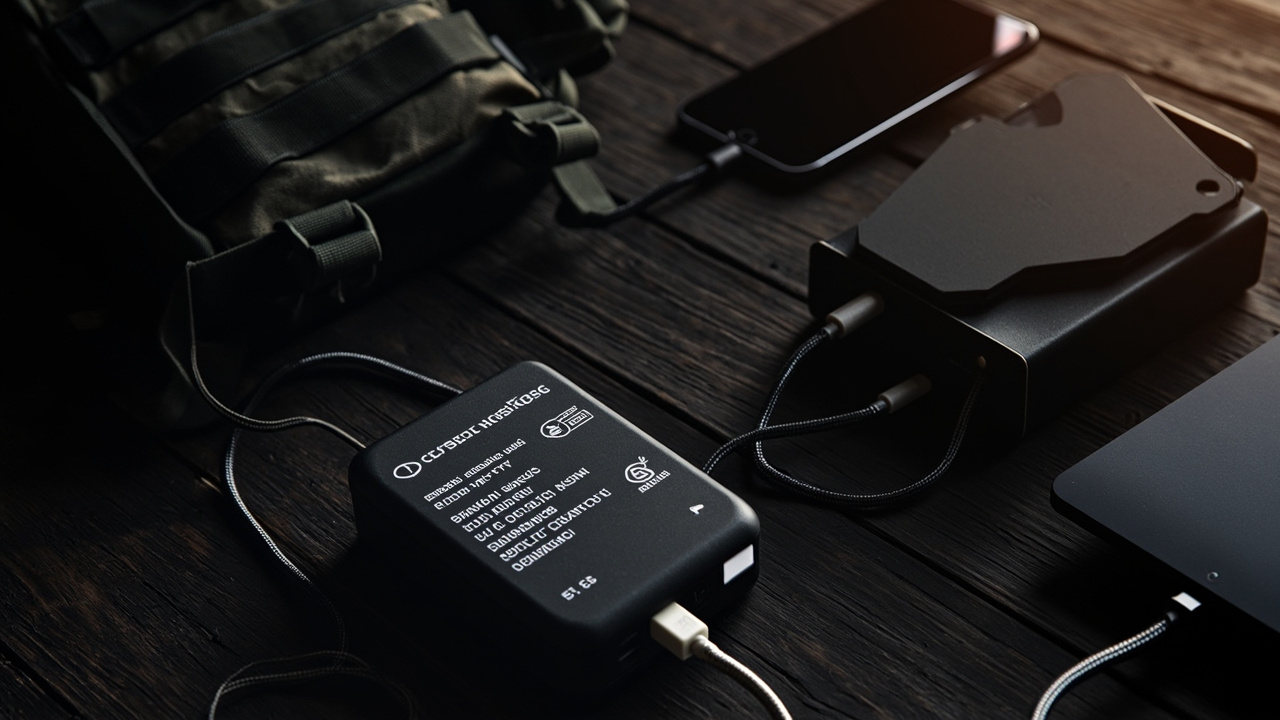
TL;DR: For a phone, iPad and laptop, choose a power bank that prints its watt-hour rating under 100 Wh and carries a UL or ETL mark for UL 2056 on the case itself, according to Komando.com.
Why this question reached a go-bag list on September 26, 2026
A listener in Washington, D.C., listening on WTOP 103.5 FM asked Kim Komando for a portable battery she could trust for a phone, an iPad and a laptop, as reported by Komando.com on September 26, 2026. The listener said she feared a fire while charging beside a bed or on a plane.
The answer published that day did not name one universal pack for all three device types. It separated a phone-size pack from a laptop-size pack and added a case-label test that applies before brand comparison. Komando.com reported 56 battery smoke-and-fire incidents on U.S. flights this year in that September 26 report.
Independent flight-risk data gives context for that concern without changing the recommendation. A sourced compilation published by SmartGadgetKit, updated October 14, 2026 with facts checked September 5, 2026, reports 123 lithium-battery overheat, smoke or fire incidents on flights in 2025, an average of 2.36 per week and up from 107 in 2024. That compilation, citing the UL Standards and Engagement aviation data review, says power banks caused 30% of passenger-flight incidents in 2025 and moved past vapes as the leading device type. The Federal Aviation Administration interactive chart cited there was last updated August 11, 2026, and the FAA cautions that the chart is not a complete list.
An August 21 cabin event shows why crews want batteries visible. American Airlines Flight 2398, an Airbus A321 from Atlanta with 133 people aboard, continued to Dallas Fort Worth International Airport and landed safely at about 6:55 p.m. local time after a passenger laptop caught fire toward the rear of the cabin, according to reporting by AirGuide published September 23, 2026. That report says flight attendants placed the device in a thermal containment bag, emergency personnel met the aircraft, and Dallas Fort Worth International Airport later said one passenger was treated and released.
The 10-second label check that outranks brand
Komando.com advises flipping any power bank over and reading two markings before purchase.
First, find the Wh number. Wh means watt-hours. Komando.com states that a bank under 100 Wh flies without asking, and that a missing Wh marking means returning the unit to the shelf.
Second, find a safety mark on the case itself. Komando.com identifies UL 2056 as the standard written specifically for power banks and directs buyers to look for the UL or ETL logo on the case. The same report lists overcharging, short circuits, drops, crushing and overheating among the tested conditions.
A technical explainer from Power Bank Tests, published September 21, 2026, narrows what that mark can and cannot prove. It identifies UL 2056 as the Standard for Power Banks and, citing UL Solutions, lists overcharge and over-discharge protection, short-circuit and overload testing, drop and impact resistance, and thermal safety. The explainer warns that a logo by itself does not establish the status of the particular unit in hand and recommends material that identifies the precise model, product name, model or type identifier, and responsible organization rather than a generic statement such as “UL compliant.”
The same explainer separates transport labeling from finished-product safety testing. It states that Subsection 38.3 of the UN Manual of Tests and Criteria addresses procedures for classification of lithium-metal and lithium-ion cells and batteries for transport, and that IATA’s 2026 operator guidance treats UN 38.3 conformance as relevant to transporting or traveling with batteries but not as a consumer-product safety standard. It also states that IEC 62133-2:2017 specifies requirements and tests for portable sealed secondary lithium cells and batteries containing non-acid electrolyte, while UL 2056 is identified as a standard for power banks as finished products.
Seller check: who actually sold the brick
Komando.com adds a marketplace step after the physical label. On Amazon, the listing should say “Ships from Amazon” and “Sold by” the brand itself. The report warns against a low-price brick from an unfamiliar third-party seller because a later safety warning may leave no accountable contact.
The Power Bank Tests explainer supports the same caution in technical terms. It states that a logo or generic marketplace statement is not enough to verify a specific product and that buyers should seek exact-model documentation naming the manufacturer or responsible representative. It also states that available evidence does not support a universal visual-authentication checklist for the marks.
For evacuation packing, that means keeping the purchase record with the device. A brand name printed on a product image does not identify the seller of record, the model revision, or the organization responsible for a certification claim. The model number on the case, the order confirmation showing seller and shipper, and any declaration or listing file that names the exact model provide the traceability that a badge alone does not.
Why Apple is not the all-devices answer
Komando.com addresses Apple directly because many iPhone and iPad owners expect a first-party battery.
Apple ended its MagSafe Battery Pack in 2023, according to Komando.com. The report states that the only battery Apple sells today is a $99 pack that fits one phone, the iPhone Air, with nothing for an iPad and nothing for a MacBook.
The report names Anker, Belkin and UGREEN as third-party alternatives, stating that those three publish safety testing, place the UL mark on the case and answer customer inquiries. That statement describes publisher-reported vendor behavior, not a certification finding for every model those companies sell. The Power Bank Tests guidance still applies model by model: identify the standard, its scope and the exact model covered.
Phone pick: Belkin 10,000mAh and magnetic option
For a phone, Komando.com names the Belkin 10,000mAh 20W pack. The report states compatibility with any iPhone, Galaxy, Pixel or Motorola with a USB-C port. It notes a built-in cable intended to prevent a forgotten cord. The listed price is about $25 and the listed energy content is 37 Wh.
For users seeking a magnetic pack that attaches to the back of the phone, Komando.com names the Anker MagGo 10K at about $80. The report states that it attaches to any iPhone 12 or newer and the Pixel 10. It adds that Samsung did not include magnets and directs Samsung owners to the Belkin wired option instead.
The 37 Wh figure matters for air movement because it sits below the 100 Wh threshold Komando.com cites for boarding without airline approval. SmartGadgetKit likewise states the FAA carry-on limit as 100 Wh per power bank without airline approval and states that power banks are never carried in checked bags.
Laptop pick: Anker Prime at the carry-on ceiling
For a laptop, Komando.com names the Anker Prime 27,650mAh 250W pack. The report lists two USB-C ports, 99.5 Wh and a price of about $180. It describes 99.5 Wh as the largest capacity a traveler can carry onto a plane without asking.
Compatibility has a hard limit. Komando.com states that the pack works with any laptop that charges over USB-C. It states that a laptop using a round barrel plug cannot be powered by a power bank and directs those owners to use the wall charger.
The 99.5 Wh rating places the unit just under the 100 Wh line. That proximity increases the importance of the printed Wh marking, the exact model identifier and the airline’s current rules. The Power Bank Tests explainer advises finding the bank’s Wh rating rather than relying on mAh alone and checking the operating airline’s current rules because guidance can change.
Nightstand and cabin routine for a packed battery
Komando.com separates home charging from flight handling.
At the nightstand, the report directs users to charge on a hard surface, never under a pillow or on a comforter, and to unplug the bank when it reaches full charge. Mint Mobile, in a September 25, 2026 battery-life guide, similarly lists heat exposure and charging under a pillow among factors that can damage a phone battery and reduce capacity, alongside staying at 100% or 0% for extended periods and using non-certified chargers or cables.
In the cabin, Komando.com directs travelers to carry the bank in carry-on baggage, never in checked baggage, and to keep charging visible in a lap or seat pocket. SmartGadgetKit gives the same carry-on-only rule and advises keeping the bank where it can be seen rather than in an overhead bin. AirGuide’s account of the August 21 American Airlines event notes that crew access and a thermal containment bag were part of the response, which aligns with keeping a suspect device reachable.
Retirement criteria are explicit. Komando.com states that a bank that puffs up, runs hot or sustains a hard drop should go to a battery drop-off, not household trash. That instruction applies equally to a bug-out rotation, where a pack may absorb vehicle heat, compression and impact between evacuations.
What to put in the bag this week
An evacuation-ready power section built from this reporting contains three layers: a phone-size bank with printed Wh and case safety mark, a laptop-size bank at or below 100 Wh where USB-C charging applies, and device cables that do not depend on memory. The Belkin unit’s built-in cable addresses cord loss for the phone layer, while the Anker Prime’s two USB-C ports address concurrent phone and laptop charging within its 99.5 Wh rating.
Documentation completes the loadout. Retain the physical case markings, the exact model number and the seller record showing shipment and sale by the brand or Amazon. Those items allow a shelter intake worker, airline agent or warranty contact to identify the configuration without relying on a marketplace photo.
The reporting does not establish one safest brand for all phones, tablets and laptops. It establishes a repeatable selection and handling sequence: verify Wh, verify the UL or ETL mark on the case for the exact model, verify the seller, keep the bank out of checked baggage, charge where overheating can be seen, and remove a damaged unit from service to a battery collection point.
Sources referenced
- ‘Kim, which battery brand is safest?’ Here’s the answer for your phone, your iPad and your laptop - Komando.com (https://www.komando.com/news/devices/kim-which-battery-brand-is-safest-heres-the-answer-for-your-phone-your-ipad-and-your-laptop-with-links-and-the-10-second-label-check-that-matters-more-than-the-brand/)
- Power Bank Certification Explained: Read Labels With Confidence | Power Bank Tests (https://www.powerbanktests.info/blog/technical-basics-safety-care/power-bank-certification-explained-read-labels/)