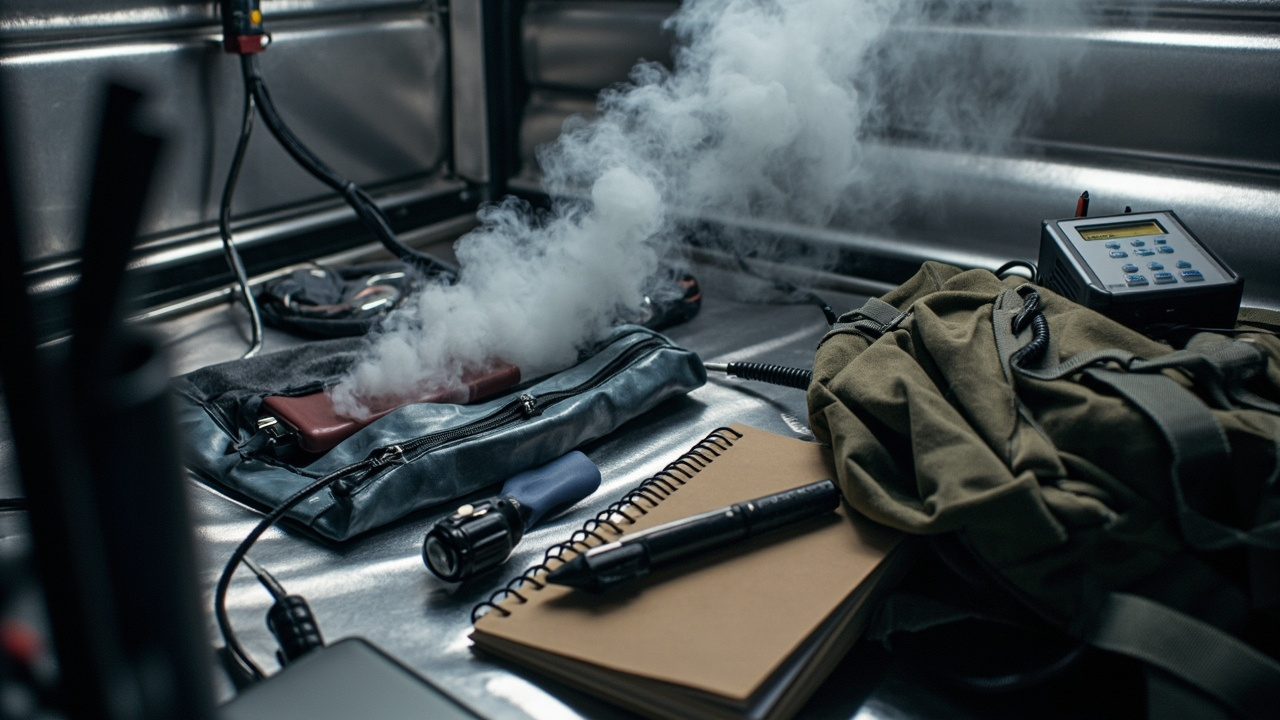
TL;DR: A 74Wh power bank forced into thermal runaway at Warwick on 21 August stayed without external flames inside a 100Wh-rated suppression bag, while the same pack in a loaded rucksack topped 300°C then ignited hours later.
What happened at Warwick
According to Firechief Global in "Behind the scenes: Putting LithShield® Fire Suppression to the test at Warwick", the day started at 9am on Friday 21 August when Krystal Suffling received confirmation of testing that morning.
According to the same Firechief Global account, Suffling traveled to the University of Warwick about two hours later for work requested by The Telegraph during an investigation into lithium battery risks on aircraft.
According to Firechief Global, Suffling serves as Firechief's NPD and Sourcing Manager and described live product testing as familiar work, with reporters present as the different element.
According to Firechief Global, the work took place with Warwick Manufacturing Group, identified as WMG, part of the University of Warwick.
According to Firechief Global, WMG has more than 15 years' experience in battery safety and abuse testing.
According to Firechief Global, its Battery Safety Centre includes seven specialist test chambers designed to allow batteries to be taken beyond normal operating limits in a controlled environment.
According to Firechief Global, the WMG team was preparing equipment on arrival while two members of The Telegraph team set up cameras around the facility.
According to The Telegraph in "This is what happens when a power bank explodes on a plane", published 27 August 2026, an experiment showed how a device stowed in hand luggage could turn into a 650C inferno.
According to author posts by Senior Travel Writer Greg Dickinson describing the Telegraph work alongside WMG at the University of Warwick, the team overheated a standard battery pack in three tests.
According to Dickinson, those three tests covered the pack on its own, in an approved fire suppression bag, and in a stuffed travel backpack.
Three power banks, three setups
According to Firechief Global, the team used a new identical model 74Wh Li-Po power bank for each of the three testing scenarios.
According to Firechief Global, the scenarios were the power bank tested on its own, inside the Firechief LithShield Fire Suppression Bag, and inside a normal rucksack containing everyday items to create a more realistic travelling scenario.
According to Firechief Global, four thermocouples continuously measured temperatures at different locations.
According to Firechief Global, those measurement points included the battery cell, heating pad and the internal and external temperatures of the suppression bag.
According to Firechief Global, the Firechief LithShield Fire Suppression Bag comes in three sizes.
According to Firechief Global, the largest version, suitable for battery capacities up to 100Wh, was used with the 74Wh power bank.
According to Firechief Global, testing is described as seeing what actually happens under controlled conditions, measuring it and learning from the result, rather than creating the neatest possible demonstration.
According to Firechief Global, once the test was complete and it was safe to do so, the bag was opened and the remains of the battery inspected.
According to Firechief Global, the observations relate to those individual tests and should not be interpreted as a guarantee of performance in every battery incident.
According to Firechief Global, battery behaviour can vary depending on chemistry, construction, capacity, condition, state of charge and the surrounding environment.
What the suppression bag did
According to Firechief Global, smoke and gases were produced as the battery failed inside the LithShield bag.
According to Firechief Global, the bag visibly inflated during that failure.
According to Firechief Global, vapour was able to vent around the zip area.
According to Firechief Global, during this particular test, no flames were observed outside the bag.
According to Dickinson, the lithium thermal runaway event behaved like a miniature flame-thrower.
According to Dickinson, the event vented 100 litres of toxic vapour that can cause permanent damage to the lungs.
According to Dickinson, damaged devices can overheat in the tested manner in the real world.
According to WMG, University of Warwick, in its 28 August travel guidance, a bucket of water is the next best option if a containment bag is not available.
According to WMG, University of Warwick, travellers should also beware of reignition after an initial fire.
According to Firechief Global, product instructions, applicable fire safety guidance and the fire risk assessment for premises should always be followed.
What the ordinary rucksack did
According to Firechief Global, the final test placed the power bank inside a normal rucksack.
According to Firechief Global, that rucksack was filled with items usually seen in a bag, such as clothes, notebooks, and a laptop.
According to Firechief Global, the team waited for the expected fire and it did not happen at first.
According to Firechief Global, the battery reached temperatures above 300°C, but the rucksack initially refused to ignite.
According to Firechief Global, the team spent longer on this test trying to drive the battery fully into thermal runaway.
According to Firechief Global, with little apparently happening, most of the team packed up and went home.
According to Firechief Global, hours later, WMG returned to check the chamber.
According to Firechief Global, the rucksack was on fire at that later check.
According to Firechief Global, WMG images showed remains of the rucksack and contents after the fire.
According to Firechief Global, the fire suppression bag was described as relatively unscathed in comparison with how bad the rucksack fire became.
According to Firechief Global, Suffling highlighted the quiet period followed by fire as one of the things that made the day particularly interesting.
According to Firechief Global, the outcome was presented as a reminder of how unpredictable battery testing can be and that an apparently quiet period did not mean the event was over.
Why aviation investigators staged the test
According to Dickinson, people had tried to describe a lithium thermal runaway event previously, but seeing it directly clarified the risk to aviation safety.
According to Dickinson, one pilot described cabin fire as a significant concern in the cockpit.
According to Dickinson, that pilot account stated that if there is a cabin fire, a pilot can have as little as 15 minutes to land the plane.
According to Dickinson, the concern is heightened above an ocean.
According to Dickinson, last year lithium devices malfunctioned on 206 flights in the UK alone.
According to Chronicle Live reporting on UK Civil Aviation Authority guidance on 28 August 2026, around two lithium battery incidents happen a week.
According to the same Chronicle Live report, cases of devices being incorrectly packed rose by 91% last year.
According to the same Chronicle Live report, the average traveller now packs around four different lithium powered devices when flying.
According to the same Chronicle Live report, 36% of travellers are unaware of the dangers of packing batteries into checked luggage.
According to the same Chronicle Live report, the authority described lithium batteries as currently posing the greatest singular threat to aircraft safety.
According to the Telegraph and Argus reporting on Jet2 guidance on 27 August 2026, an EasyJet flight from Egypt to London Luton was diverted to Rome earlier this year after a power bank was found to be charging in passenger luggage.
What it means for a go-bag power bank
According to WMG, University of Warwick, lithium-ion batteries should be kept out of checked-in luggage, with rechargeable items assumed to contain a battery.
According to Chronicle Live, citing the UK Civil Aviation Authority, passengers are reminded to keep items such as mobile phones, vapes and power banks in hand luggage.
According to Chronicle Live, passengers are reminded never to charge a power bank during a flight.
According to the Telegraph and Argus, Jet2 reminded passengers that power banks and e-cigarettes must be carried in hand luggage, not placed in hold baggage.
According to the Telegraph and Argus, Jet2 urged travellers to store power banks and e-cigarettes under the seat in front of them.
According to the Telegraph and Argus, passengers were advised to ensure items are switched off, securely packaged and have exposed terminals protected to prevent short circuits.
According to the Telegraph and Argus, damaged devices or batteries are not permitted on board.
According to WMG, University of Warwick, travellers should buy reputable products and look for the CE mark.
According to WMG, University of Warwick, travellers should never use damaged batteries, cables or devices.
According to WMG, University of Warwick, travellers should only use the original charging cable.
According to WMG, University of Warwick, charging devices should be kept within sight when on board.
According to WMG, University of Warwick, devices should not be left charging in a bag or in the overhead locker.
According to WMG, University of Warwick, if a battery gets hot, smokes, leaks or smells unusual, cabin crew should be told immediately.
For a bug-out bag or evacuation go-bag, the practical consequence drawn from these stated facts is to treat the power bank as cabin-style cargo: carried where it can be seen, smelled and reached.
For a bug-out bag, the tested size relationship was a 74Wh Li-Po power bank inside a bag version suitable for battery capacities up to 100Wh.
For a bug-out bag, the tested rucksack contents of clothes, notebooks and a laptop show how ordinary packing can become fuel once delayed ignition occurs hours after temperatures exceed 300°C.
For a bug-out bag, the WMG instruction to beware reignition means a pack that looks quiet after venting cannot be treated as finished.
Announcement status and limits
According to Firechief Global, the article is a behind-the-scenes account of testing carried out by Warwick Manufacturing Group under controlled conditions using a specific 74Wh Li-Po power bank and defined test setup.
According to Firechief Global, Firechief LithShield Fire Suppression Bags are available in three sizes for different battery capacities.
This report describes completed tests on 21 August and coverage published 27-28 August 2026, not a future product launch.
No future deployment, certification action or shelter-supply rule change is announced in the cited testing accounts.
Sources referenced
- Behind the scenes: Putting LithShield® Fire Suppression to the test at Warwick | Firechief Global (https://firechiefglobal.com/behind-the-scenes-lithshield-testing-warwick/)