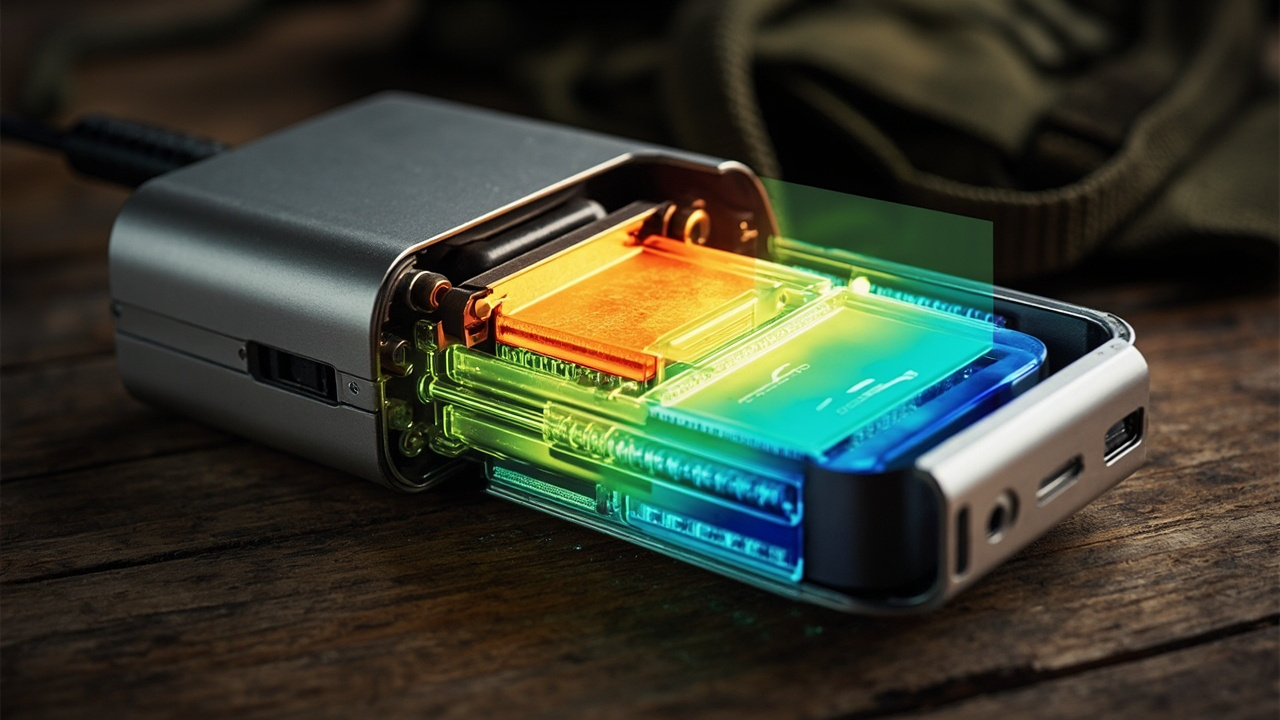
Teardown Finds UGREEN's Liquid-Cooled Bank Runs Hotter Than Claimed, Still Reveals Loadout Win
TL;DR: An independent September 18, 2026 teardown found UGREEN's MagFlow Pro 10,000mAh magnetic bank hit 41°C during sustained 25W wireless output, not 36°C, while confirming a working micro-pump loop, aluminum frame, and 45W wired output.
The newest verified finding is a temperature gap. According to FastTube, creator Ichiken measured about 41°C maximum surface temperature during continuous 25W wireless output at 25°C room temperature using a Qi2 trigger device to hold wireless charging stable. According to FastTube, UGREEN describes the result as about 10°C lower than competing products during wireless charging, with the unit staying around 36°C. According to FastTube, Ichiken attributed the difference to different test conditions rather than a false claim.
That distinction matters for a bug-out bag. A bank that still reaches 41°C on its hottest spot is not cool to the touch in the marketing sense, but the teardown shows where that heat sits, how the case moves it, and why wired charging remains the faster, cooler path when power is limited.
What was tested on September 18, 2026
According to FastTube, the product examined was the UGREEN MagFlow Pro 10,000mAh magnetic power bank whose selling point is an active liquid-cooling system. According to FastTube, when it starts charging a device, liquid visibly begins circulating inside the unit. According to FastTube, Ichiken normally tries to avoid reviewing power banks, but made an exception because of the unusual cooling mechanism.
According to FastTube, the piece is not a review of the product as a charger. According to FastTube, it is a teardown focused on how the cooling works and whether the internal design matches the marketing.
A second independent hands-on account supports the basic hardware description. According to G Style Magazine, the reviewer spent time with the MagFlow Pro Qi2 25W Magnetic Power Bank combining a 10,000mAh battery with up to 25W Qi2.2 wireless charging on compatible devices, 45W wired USB-C output, a built-in USB-C cable, a smart display, and UGREEN's CryoPulse liquid-cooling system. According to G Style Magazine, the review was published on September 16, 2026.
According to M1k Tech, the model number is PB793, replacing last year's PB773. According to M1k Tech, the author attended the Gillette Stadium event where UGREEN rolled out the bank alongside the HomeAgent smart home lineup.
How UGREEN says CryoPulse is supposed to work
According to FastTube, UGREEN describes the product as using active cooling that circulates liquid internally, plus copper foil and an aluminum shell. According to FastTube, Ichiken noted that a REDMAGIC smartphone previously disassembled used a similar mechanism.
According to G Style Magazine, CryoPulse uses a micro-pump that circulates coolant through the power bank to move heat away from critical charging components. According to G Style Magazine, copper material and internal component separation assist with thermal management, while UGREEN's Thermal Guard system monitors temperature and can adjust power accordingly.
According to M1k Tech, the pump circulates coolant past the charging coil, VC copper foil spreads heat where it matters, and the internal layout physically separates the coil from the cells. According to M1k Tech, UGREEN calls the cell architecture Dymondcell 2.0, with 13 layers of circuit protection. According to M1k Tech, UGREEN lists a 4mm tungsten nail penetration test, a 2.5-tonne crush test, and a seven-hour overcharge run at 135°C that ended without fire. According to M1k Tech, Thermal Guard samples the temperature 240 times a second and trims output to stay inside limits. According to M1k Tech, the author states that those safety results cannot be verified from a desk.
For a go-bag, the separation point is practical. According to M1k Tech, coil heat is uncomfortable while cell heat shortens pack life. According to M1k Tech, the internal layout physically separates the coil from the cells.
Measured output: 25W wireless, 29W from the cells
According to FastTube, the back has a Qi2-compatible wireless charging pad rated at up to 25W. According to FastTube, in Ichiken's test it reliably drew 25W. According to FastTube, with 25W going out, the battery was delivering about 29W, so roughly 4W was lost. According to FastTube, Ichiken attributes this to the wireless coil stage being less efficient than wired charging.
According to FastTube, the wireless pad is output-only and cannot recharge the power bank. According to FastTube, a side display shows remaining charge and charging status.
According to M1k Tech, the wireless output is Qi2.2 certified, up to 25W. According to M1k Tech, that 25W ceiling applies to the iPhone 17 series, iPhone 16 series on iOS 26 or later, the Galaxy S26 Ultra, and the Pixel 10 Pro XL. According to M1k Tech, the iPhone 16 and 16 Pro cap at 22W, the iPhone Air and S26+ at 20W. According to M1k Tech, everything from the iPhone 12 through 15, the Pixel 10 and 10 Pro, and the whole Galaxy S25 range drops to 15W, with Samsung's S25 phones needing a magnetic case fitted before wireless works at all.
According to G Style Magazine, the reviewer primarily used the bank with a Samsung Galaxy S24 Ultra. According to G Style Magazine, UGREEN continues to heavily market MagFlow toward Apple's ecosystem.
Measured heat: 41°C peak with a 6°C spread
According to FastTube, Ichiken measured temperatures during continuous 25W wireless output at a room temperature of 25°C. According to FastTube, the maximum surface temperature was about 41°C.
According to FastTube, UGREEN tested with an iPhone 17. According to FastTube, Ichiken doubts that an iPhone would actually charge wirelessly at a constant 25W, so a difference of a few degrees is expected.
According to FastTube, the heat was unevenly distributed. According to FastTube, the hottest spot was 41°C while the center was 35°C, a spread of about 6°C. According to FastTube, Ichiken guesses that the hottest area might contain a conversion circuit that adapts the battery voltage for wireless charging.
According to FastTube, on the coil side the wireless charging coil ran very hot. According to FastTube, because the Qi2 trigger sends its power to an external electronic load, this heat came purely from the coil, and it corresponds to the coil's power loss. According to FastTube, Ichiken comments that transmitting as much as 25W through a wireless coil requires enough current to generate some heat.
According to FastTube, UGREEN states that the cooling system itself draws only 0.02W. According to FastTube, the active liquid cooling starts when the bank begins charging another device.
Inside the case: aluminum perimeter, resin base, and stacked board
According to FastTube, Ichiken started cutting the case with an ultrasonic cutter, but something felt wrong. According to FastTube, the entire outer perimeter of the case turned out to be aluminum, so the work switched to filing it apart.
According to FastTube, the structure has three main parts: a resin base that holds the charging circuitry, an aluminum frame that wraps all the way around, and a lid on top. According to FastTube, Ichiken assumes aluminum was chosen over plastic because it conducts heat well.
According to FastTube, a power bank runs at a lower temperature, around 40°C, which a person can tolerate touching even on metal. According to FastTube, it is not connected to mains power, and its highest voltage is around 20V. According to FastTube, Ichiken thinks that is why aluminum is acceptable, while a metal exterior is not used on a wall charger.
According to FastTube, the attached USB cable runs inside to a flexible printed circuit soldered to an adapter board, which connects to the internal circuit board through a connector.
According to FastTube, the core of the unit is a battery cell integrated with a printed circuit board. According to FastTube, the Qi transmitter coil sits on the back. According to FastTube, the board holds the charge/discharge control, the power conversion circuits, and the Qi coil driver, so it generates a lot of heat, and it matches the hot area in the earlier thermal images.
According to FastTube, the board has two layers with a silicone heat-dissipation sheet between them, apparently to spread heat evenly across the whole area. According to FastTube, the Qi coil wiring runs along the outer casing, and that also matches a localized hot spot in the thermal footage.
According to G Style Magazine, the upper portion features a transparent green window that allows viewing the liquid-cooling system operating inside. According to M1k Tech, the body is 16.2mm thick with a window on the front to watch the coolant move. According to G Style Magazine, there is a separate display along the side providing remaining battery capacity and real-time charging wattage. According to M1k Tech, the display includes live in/out wattage, plus a front animation LCD.
Cells, voltage, and why two 5,000mAh cells are in series
According to FastTube, the battery is two 5,000mAh cells connected in series, for 39.2Wh. According to FastTube, more power banks now use two cells in series.
According to FastTube, most USB devices charge over USB PD at around 9V, 15V, or 20V. According to FastTube, if the battery voltage is low, the boost ratio increases, and so does the loss in the power bank's conversion circuit. According to FastTube, raising the pack voltage, even slightly, is a way to deliver as much of the stored energy as possible to the device being charged.
According to M1k Tech, capacity is 10,000mAh, 39.2Wh at 7.84V. According to M1k Tech, the cells are two 5,000mAh ATL lithium-ion cells in series. According to M1k Tech, rated energy went up about 9% on the same two cells compared with 36Wh at 7.2V in the prior model, which suggests a shift from lithium polymer to lithium-ion.
Wired power is the bigger change for an evacuation kit
According to FastTube, the power bank has a built-in charging cable that can also serve as a strap, plus one USB-C port. According to FastTube, both are labeled IN/OUT, so either can charge the power bank or charge other devices. According to FastTube, wired output reaches up to 45W, and maximum input is 30W.
According to G Style Magazine, wired output reaches 45W through either the integrated USB-C cable or USB-C port, while the power bank itself can recharge at up to 30W. According to G Style Magazine, the integrated braided USB-C cable doubles as the carrying loop. According to G Style Magazine, there is a separate USB-C port, so the reviewer rarely felt the need to bring another cable specifically for the power bank.
According to M1k Tech, 45W is available out of either the built-in cable or the second USB-C port through 20V/2.25A. According to M1k Tech, that output is a 50% jump over the outgoing model. According to M1k Tech, 45W puts the unit within range of a tablet or a light laptop rather than just topping up a phone.
According to M1k Tech, running the wired port and wireless pad together gives 10W wired plus 5W wireless. According to FastTube, the multi-port power split was shown in an on-screen chart.
According to M1k Tech, the size is 108.4 x 70.5 x 16.2mm and the weight is 230g. According to G Style Magazine, the weight is around 230 grams. According to G Style Magazine, it remains compact enough for a bag or pocket, but the added weight is noticeable when the unit is magnetically attached to a larger phone such as the S24 Ultra.
Price and loadout consequence
According to FastTube, Ichiken paid 18,980 yen, and the price later dropped to 14,180 yen. According to FastTube, even with 25W Qi2, about 40Wh of capacity, and active cooling, the product was considered expensive. According to FastTube, Ichiken bought it only to take it apart and did not think it was good value. According to FastTube, its performance is above average, but its price is even further above average. According to FastTube, for value, UGREEN's other Qi2-compatible power banks were suggested instead.
According to M1k Tech, street price is about $110 to $150 / £109.99. According to M1k Tech, the cable sits slightly proud of the body rather than tucking into a recess as on the PB773, which is noticeable when pulling the unit from a bag.
For a bug-out bag, the teardown points to a narrow use case. Pack the MagFlow Pro as a single-device fast charger with its own cable attached, use the 45W wired path for phones, tablets, or light laptops, and treat magnetic wireless as a convenience mode that wastes about 4W and concentrates heat in the coil and conversion area. Do not plan to recharge the bank from its own wireless pad, because that pad is output-only. Do not plan to fast-charge two devices at once, because combined output falls to 10W wired plus 5W wireless. The visible coolant loop is functional, but the measured 41°C peak shows that liquid circulation does not remove the need to keep the bank ventilated, separated from insulation, and off heat-sensitive gear during a sustained wireless session.
Sources referenced
- Inside UGREEN's "Liquid-Cooled" Power Bank: A Teardown of the MagFlow Pro 10,000mAh | FastTube (https://fasttube.cc/en/v/yALZTbBB_J0)
- UGREEN MagFlow Pro Qi2 25W Liquid Cooled Power Bank 10000mAh [Review] – G Style Magazine (https://gstylemag.com/2026/09/16/ugreen-magflow-pro-qi2-25w-liquid-cooled-power-bank-10000mah-review/)