TL;DR: One Finnish pouch cell produced two conflicting energy figures and no durability proof.
Six independent examinations of the Donut Lab pouch cell have left its two most important specifications unresolved. Finland's national laboratory recorded 409.3 watt-hours per kilogram under gentle conditions in early September, while a June researcher-led review calculated roughly 298 watt-hours per kilogram for the same design, a gap of more than a third. Neither program published a cycle-life curve for the advertised 100,000-cycle design life.
That is the finding that matters for anyone who carries power in a bug-out bag. A lighter pouch means less pack weight for the same stored energy, but only when the watt-hours, test rate, voltage limits, and long-term fade are all disclosed together.
What happened on Sept. 2
According to Electrek, Donut Lab published its first on-record energy-density figure after months of scrutiny.
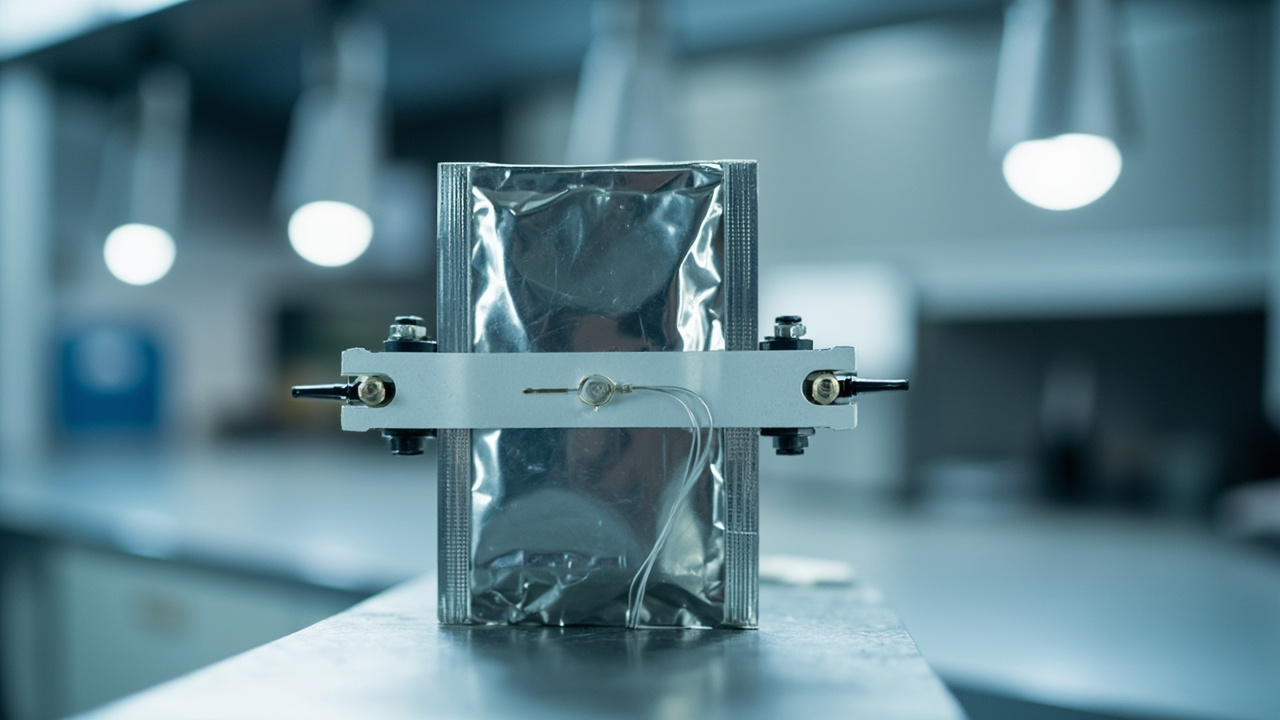
The report came from VTT Technical Research Centre, Finland's national laboratory. Technicians weighed and measured a single cell identified as Donut Battery V1.5, designated DL6, then fully charged it and discharged it across 2.3 to 4.25 volts at a 0.1C rate at 25 degrees Celsius. Energy divided by mass gave 409.3 watt-hours per kilogram; energy divided by volume gave 804.7 watt-hours per liter.
The company presented the result alongside separate work by testing firm Intertek. According to Automotive World, Intertek examined next-generation cells, reported multiple electrochemical layers connected in series inside one cell with split metal foils as electrodes on both sides, and monitored a fully charged cell for one hour after a steel nail was driven through it. The cell produced no thermal runaway, smoke or fire during that period.
VTT made no determination about chemistry. The term solid-state appeared in its report only as the customer's project name.
Why the same cell can show two different densities
According to Energies Media, energy density is watt-hours divided by mass, but the numerator changes with the way power is withdrawn.
A discharge at one-tenth of capacity per hour lets internal resistance take very little energy as heat, so almost all stored charge is counted. A discharge at a 1C rate, the rate a vehicle actually demands, loses more energy as heat and returns a lower number. Widening the voltage window also raises the counted energy, because charge is taken from a range that a production battery management system would normally block.
The VTT energy result used the most generous combination: ten times slower than an earlier 1C capacity test, and 0.4 volts deeper, down to 2.3 volts rather than 2.7 volts. The earlier approach therefore cannot be compared directly with the newer figure without adjusting for rate and voltage limits.
VTT also described the DL6 as an energy-optimized variant of the V1 cell. That distinction matters because the public record now covers at least three different cells: the V1 examined in the spring, the V1.5 measured for energy, and a separate next-generation cell examined by Intertek.
The competing 298 Wh/kg calculation
The alternative figure did not come from the national laboratory. It came from an investigation published in June by an independent battery researcher working with more than 20 experts drawn from a German research institute, two European universities and a Finnish polytechnic.
That group calculated roughly 298 watt-hours per kilogram and disputed that the chemistry was novel. It cited voltage behavior at 3.7 to 3.8 volts at half charge and an expansion signature it interpreted as a graphite anode, both consistent with conventional high-nickel lithium-ion.
No reconciliation between the 409.3 and 298 figures has been published. The two results describe the same Finnish program, were produced by credible examiners, and remain more than a third apart.
Context helps explain why 409.3 alone does not answer the chemistry question. Top commercial high-nickel cells sit around 250 to 300 watt-hours per kilogram, while Amprius already sells a conventional liquid-electrolyte silicon-anode lithium-ion cell rated at 450 watt-hours per kilogram. Solid-state pilots from QuantumScape, Toyota and Samsung SDI target 350 to 450 watt-hours per kilogram. A 409.3 result therefore sits inside what advanced lithium-ion already achieves.
Six tests, but no cycle life
The durability gap is larger than the density gap. Donut Lab has advertised a design life of up to 100,000 cycles, against the 1,000 to 5,000 cycles that good cells manage now. At one charge per day, 100,000 cycles would represent roughly 270 years of use.
Six independent tests have not measured that claim. The September energy test ran two capacity cycles and stopped. The only cycling data on record came from a run on a cell that was already compromised: 50 cycles at five times capacity took capacity from 24.689 amp-hours to 11.194 amp-hours, a 55 percent collapse. That result proves nothing about a healthy cell, and it leaves the most ambitious specification with the least evidence.
Other VTT runs established narrower points. One cell reached 80 percent charge in four and a half minutes at an eleven-times-capacity rate. Another survived discharge at 212 degrees Fahrenheit, although the pouch lost its vacuum seal during the run. A third retained 97.7 percent charge after ten days sitting idle. At pack level, a motorcycle accepted 100 kilowatts of charging and held it. None of those runs measured energy density, and none measured cycle life.
The structural argument also remains incomplete. Donut Lab has said that a bipolar internal structure is possible only with a solid electrolyte. What Intertek reportedly confirmed was the structure — series-connected layers with split metal-foil electrodes — not that the electrolyte itself was solid, and that examination was performed on a different cell than the one that produced the 409.3 figure. A nail-penetration result showing stability is a genuine safety result, but many lithium-ion and lithium-iron-phosphate cells also pass such a test, so safety alone does not establish chemistry.
The missed production-vehicle promise
The original commercial promise was not a laboratory number. When Donut Lab unveiled the battery at CES in January, it called the product the world's first solid-state battery ready for use in original-equipment vehicle manufacturing and said Verge Motorcycles would be the world's first production vehicle to use it, with first deliveries in the first quarter of 2026.
That schedule is now the clearest failed test. September arrived with no production electric vehicle running the battery on the road. Internal videos surfaced in a June investigation showed pre-production motorcycles being used to refine manufacturing. Chief Executive Marko Lehtimäki later said in Finnish media that the cell being tested was not even the cell intended for customers.
Former commercial chief of manufacturing partner Nordic Nano, Lauri Peltola, alleged in an April criminal complaint that the independently tested battery was an old generation the company and its partners had abandoned. Donut Lab denied wrongdoing. Finnish financial and criminal authorities were reported to be examining the company, and no finding against it had been made.
The financial exposure is concentrated among small holders. The company raised about 25 million dollars from more than 1,300 shareholders through a Finnish crowdfunding platform, with more than 900 holders owning fifty shares or fewer, a pattern describing retail investors rather than funds able to absorb a loss.
Chief Technology Officer Ville Piippo called the energy test fairly straightforward, a description that underscores why its absence from the first five VTT tests drew attention. Chief Executive Marko Lehtimäki said the measurement and other spring results showed exceptional innovation and unlimited possibilities through relatively light optimization, and said the company had focused since launch on next-generation cells and intended to scale their production to industrial level. Those statements describe plans and an announcement, not completed production.
What this means for a bug-out power loadout
For evacuation kits, the lesson is to treat unverified density and life claims as zero in planning.
A verified 409.3 watt-hour-per-kilogram pouch would reduce the mass needed for a given reserve, which matters when every ounce is carried on foot. A 298 figure would place the same pouch near existing high-nickel practice, meaning no weight advantage over proven portable power. Because both figures remain on record without reconciliation, a prudent loadout cannot assume either one for shelter or field use.
Cycle life controls replacement timing. A pack that fades by more than half in dozens of cycles would require frequent rotation and testing, while a proven 1,000- to 5,000-cycle cell supports a predictable inspection schedule. With no published capacity curve for a healthy Donut cell at a realistic rate, there is no basis to assign it a place in a go-bag, vehicle kit, or home reserve.
Safety testing is useful but separate. One hour without fire after nail penetration is encouraging for storage near fuel, clothing and documents. It does not establish chemistry, longevity, or compatibility with a production battery management system limited to a narrower voltage range.
Until a healthy cell is cycled at a realistic rate with its capacity curve, voltage curve, capacity, weight and dimensions published together, the practical choice remains chemistry that is boring and proven.
Sources referenced
- Donut Lab hits 409 Wh/kg in battery lab test, but credibility is gone | Electrek (https://electrek.co/2026/09/02/donut-lab-409-whkg-battery-test-no-production-ev/)
- After 6 independent tests on the same Finnish cell, the energy density figures still disagree by more than a third and the cycle life claim that made the company famous has no test behind it at all (https://energiesmedia.com/finnish-cell-energy-density-disagreement-cycle-life-still-untested/)