TL;DR: The new ANSI/ISEA Z308.1-2026 workplace first-aid standard adds naloxone and stronger bleeding-control and training guidance, and Padagis announced free naloxone for early business adopters.
New national standard rewrites what belongs near the kit
The International Safety Equipment Association released ANSI/ISEA Z308.1-2026, the American National Standard for Minimum Requirements for Workplace First Aid Kits and Supplies, according to the ISEA report titled Updated Workplace First Aid Standard Adds Naloxone Amid Growing Overdose Crisis.
The release described the document as the sixth revision of a standard first published in 1978. The revision addresses opioid overdose response, bleeding control, tourniquet specifications, and emergency preparedness for mobile workers.
The National Safety Council addressed the same revision in its National Safety Council Statement on Updated Workplace First Aid Kit Standard Incorporating Opioid Overdose Response and Enhanced Training Guidance. That statement said the updated standard reflects evolving workplace risks, adds naloxone, and introduces first-aid training guidance.
Compliance with ANSI/ISEA Z308.1-2026 is voluntary, according to Occupational Health & Safety in its article Updated First Aid Standard Expands Overdose Response and Emergency Training. The National Safety Council statement said the Occupational Safety and Health Administration refers to the consensus standard as a guideline for employers.
ISEA described ANSI/ISEA Z308.1 as a voluntary consensus standard referenced by OSHA as a recommended minimum guideline for workplace first-aid supplies. ISEA said the standard is widely adopted across industries and has been incorporated into occupational safety regulations in numerous states.
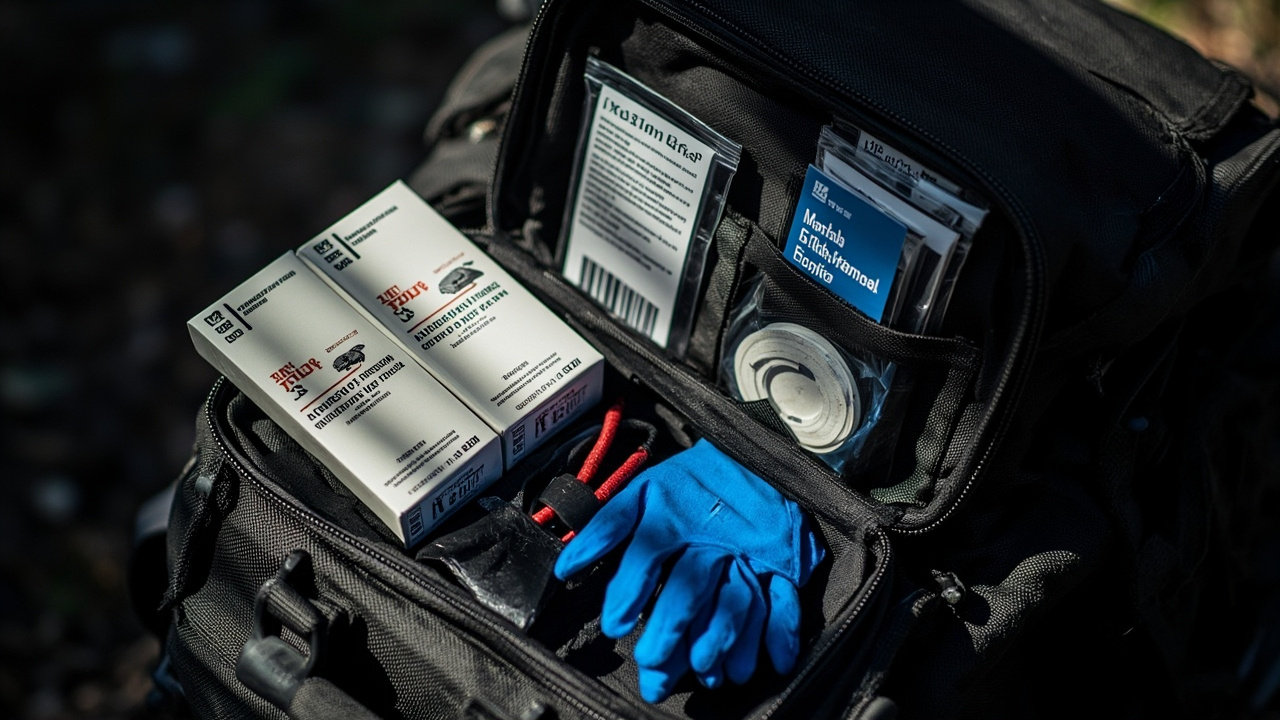
For people who maintain a bug-out bag, vehicle bag, or everyday carry pouch, the release matters because many households build those loadouts from workplace-style kits. The revision changes the recommended supplemental contents, the bleeding-control definitions, the field-worker handling rules, and the language of the printed guide that accompanies each kit.
Naloxone becomes a recommended supplemental item
One of the most significant updates is the inclusion of naloxone, an opioid overdose reversal medication, as a recommended item in or near workplace first-aid kits, according to the ISEA report.
Workplaces are encouraged to keep at least two naloxone nasal sprays in a clearly labeled kit near other emergency supplies, stored in plain view, the ISEA report said.
Occupational Health & Safety described naloxone under the 2026 revision as a supplemental supply that employers can consider when evaluating workplace risks and first-aid needs. The National Safety Council statement similarly described naloxone as an added overdose-reversal medication.
The updated guidance encourages employers to make naloxone available for emergency use, store it in clearly visible and accessible locations near other first-aid equipment, and ensure that kits contain at least two doses, according to the September 21, 2026 Padagis announcement titled Padagis Expands Workplace Naloxone Access, Providing Free Nasal Sprays to Qualifying Businesses.
That announcement also said naloxone is safe to administer even when opioids are not present, a point presented as a way to reduce hesitation during critical response moments.
“First aid supplies should be ready for the emergencies most likely to happen in your workplace,” said Cam Mackey, President and CEO of ISEA, as quoted in the ISEA report.
The National Safety Council statement quoted NSC CEO Lorraine Martin saying, “With 8% of workplace deaths caused by drug overdose, employers must be prepared to act quickly to save a life.”
The ISEA report cited a National Safety Council survey finding that only 28 percent of employers report being fully stocked with naloxone at worksites. The National Safety Council statement separately said only 28% of employers report having naloxone at worksites, according to an NSC survey.
The ISEA report said fatal overdoses account for nearly 10 percent of workplace deaths. It also cited Centers for Disease Control and Prevention data that more than 80,000 people died from drug overdoses in 2024, with the majority involving opioids.
Announcement: free sprays offered to first 200 businesses
Padagis announced on September 21, 2026, a workplace preparedness initiative to expand access to naloxone in workplaces nationwide, offering free naloxone nasal spray to qualifying businesses. This is an announcement of a planned giveaway, not a completed distribution result.
Padagis said it will provide two free naloxone nasal sprays to the first 200 businesses that apply through its workplace preparedness program, according to the Padagis announcement.
The program is directed in particular toward industries where risk may be higher, including construction, manufacturing, hospitality, and food service, the announcement said.
Businesses can seek information or apply by contacting [email protected] or visiting naloxoneworkplace.com, according to the announcement.
“Workplace safety has evolved, and emergency preparedness must evolve with it,” said Pamela Hoffman, CEO of Padagis, as quoted in the announcement. The announcement also quoted Hoffman saying that when naloxone is readily available, properly labeled, and paired with training, it can make the difference between life and death in an emergency.
“The updated ANSI/ISEA standard recognizes that overdose preparedness is becoming an increasingly common part of workplace safety,” said Cam Mackey, President and CEO of ISEA, as quoted in the Padagis announcement.
Padagis, based in Allegan, Michigan, described itself as a provider of affordable generic pharmaceuticals and said one of its flagship products is naloxone, an over-the-counter nasal spray that acts as an antidote for opioid overdoses.
The National Safety Council said it supports the bipartisan Workplace Overdose Reversal Kits (WORK) to Save Lives Act, which would expand access to naloxone nationwide. The Council said it has led efforts to reduce preventable overdose fatalities since 2012 through research, employer resources, policy advocacy, and education programs.
Tourniquet language targets counterfeits and wrong product type
Beyond naloxone, the revised standard clarifies tourniquet specifications to distinguish arterial tourniquets from the elastic bands used for drawing blood, which are not effective at stopping blood loss, according to the ISEA report.
The standard also flags a proliferation of counterfeit tourniquets as an active concern for employers, the ISEA report said.
That distinction is directly relevant to a compact evacuation or vehicle kit. An elastic phlebotomy band and an arterial tourniquet may look superficially similar in a crowded pouch, but the revised standard treats only the arterial design as relevant to stopping blood loss.
Bleeding-control guidance now addresses supplemental bleed-control kits for employers in higher-risk environments, according to the ISEA report. The listed examples are chest seals, hemostatic bandages, compression bandages, and thermal blankets.
For a personal loadout, the practical implication is to avoid counting a venous band as bleeding control. Keep any arterial tourniquet accessible and identifiable, rather than folded beneath routine bandages, and retain protective gloves so a helper can replace contaminated or torn gloves.
Mobile workers, training, and bilingual guide get new guidance
Guidance on mobile and field workers now addresses how to assess hazards across changing job sites, when to bring first-aid kits from vehicles to worksites, and how to manage restocking in the field, according to the ISEA report.
That vehicle-to-worksite point is important for tourers and commuters. A kit left permanently in a trunk does not satisfy the updated concept if the user has moved to a job site, trailhead, campsite, or shelter location. The guidance contemplates carrying the kit to the work area and maintaining a restocking method while away from a central supply cabinet.
Guidance on first-aid training and emergency response readiness has been added to cover CPR and AED preparedness, staffing levels for trained responders, product-specific awareness training, and more, the ISEA report said.
Occupational Health & Safety said the revision adds guidance for training workplace personnel in first aid, cardiopulmonary resuscitation, and automated external defibrillator use. The National Safety Council said that guidance is especially relevant where emergency medical services may not be immediately available.
The revision also updates guidance on anti-choking devices as supplemental supplies, according to the ISEA report.
The First Aid Guide that accompanies each first-aid kit must now be provided in both English and Spanish, the ISEA report said.
“Conformance to ANSI/ISEA Z308.1-2026 gives employers confidence that their workplace first aid supplies are aligned with current best practices and evolving occupational risks,” said Todd Van Houten, Chair of the ISEA First Aid Product Group, as quoted in the ISEA report.
The National Safety Council said it worked alongside ISEA to advance the inclusion of naloxone and stronger first-aid training guidance. The Council offers a free tool to help build opioid overdose response plans at nsc.org/overdosetool and free eLearning on how to administer naloxone.
What this means for a practical mini-kit loadout
A mini tourer kit should now be evaluated as a capability set rather than a piece count, with overdose response, bleeding control, mobility, and readable instructions treated as separate capabilities.
For overdose readiness, the standard points toward two naloxone nasal sprays, clearly labeled, visible, and stored near other emergency supplies. The Padagis announcement presents the same two-dose quantity as its giveaway amount for qualifying businesses. Households assembling a go-bag can apply the same visibility principle: avoid burying time-sensitive medication beneath routine items.
For bleeding control, retain disposable nitrile gloves in multiple pairs, sterile gauze, and an absorbent trauma dressing as a baseline, and treat chest seals, hemostatic bandages, compression bandages, and thermal blankets as supplemental additions for higher-risk environments identified in the standard. Verify that any tourniquet is an arterial design, not an elastic blood-draw band, and be aware of the counterfeit concern flagged in the standard.
For mobility, plan the pouch so it can move from vehicle to person. The mobile-worker guidance emphasizes bringing the kit from the vehicle to the worksite and managing restocking in the field. A practical translation is a small, self-contained pouch with its own gloves, dressings, personal medicines list, and response reference, rather than loose supplies scattered across compartments.
For usability, keep the printed First Aid Guide with the kit and account for the new English-and-Spanish requirement when replacing a workplace kit. Add only items someone knows how and when to use, because unfamiliar equipment can delay appropriate care. Inspect medicines, sterile packaging, batteries, and temperature-sensitive products regularly, and treat the kit as support for immediate care rather than a substitute for emergency services or medical training.
Regulatory backdrop still developing
The timing aligns with growing legislative momentum, according to the ISEA report.
New York enacted legislation last year requiring employers subject to OSHA first-aid requirements to maintain an opioid antagonist, such as naloxone, as part of workplace supplies, with a full effective date of December 13, 2026, the ISEA report said.
California has enacted a law requiring Cal/OSHA to draft regulations mandating naloxone nasal spray in workplace first-aid kits, with the Standards Board required to adopt revised standards by December 31, 2026, the report said.
The updated ISEA standard gives employers a voluntary framework to get ahead of that regulatory curve now, the report said.
No completion of those future state actions was reported in the sources available by September 22, 2026. Employers and kit builders should treat the state dates as upcoming deadlines described in the September 17 reporting, not as completed mandates.