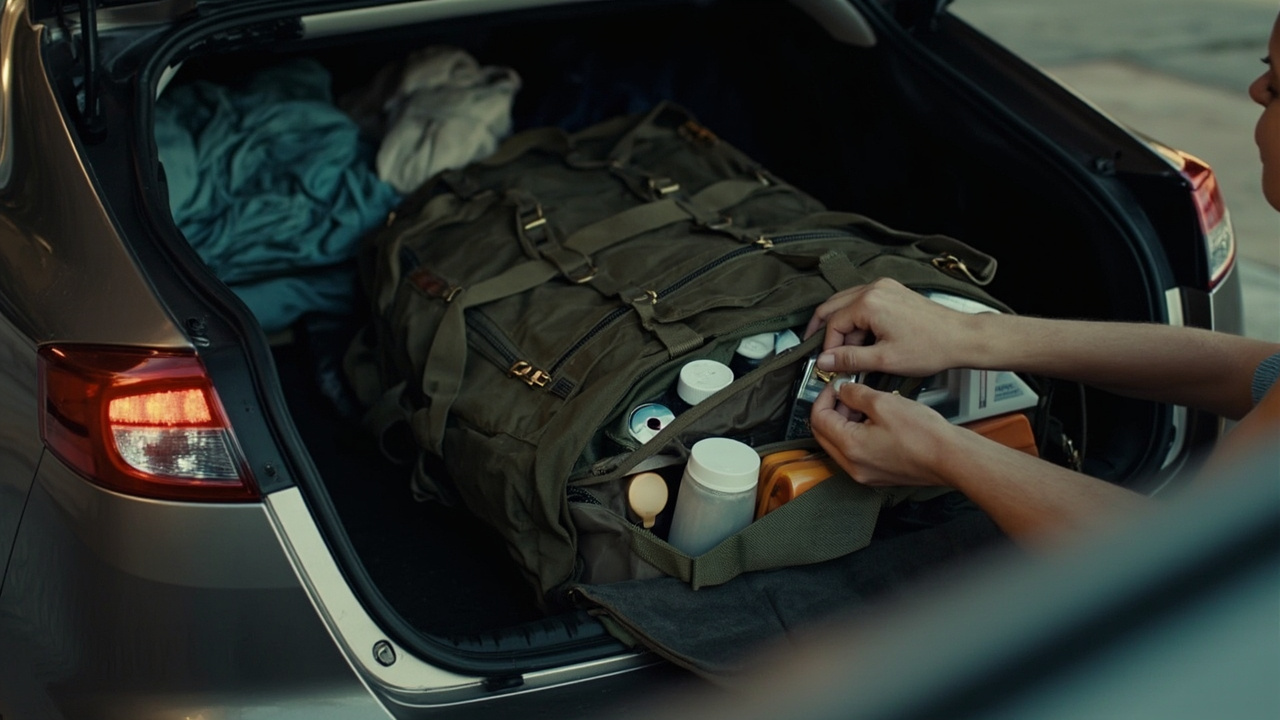
TL;DR: Florida evacuees say a realistic bug-out bag works best as a weekend trip bag plus documents, medicines, chargers and basic comfort supplies, not a wilderness survival kit.
Most emergency evacuations end with a car ride to a hotel, a relative's house, or a public shelter, and that destination shapes what belongs in the bag. That question was at the center of a discussion on the r/prepping subreddit described by Florida evacuees say a realistic bug-out bag looks more like a weekend bag than a survival kit, where one user said they were trying to prepare their family for realistic emergencies rather than a worst-case fantasy scenario.
A weekend bag, not a wilderness kit
The original poster asked how to decide what is really needed: "What instance would make sense to not just have your toiletries, electronics, clothes etc packed and instead have real survival gear like a radio etc?"
Commenters largely answered that the key is less about packing the right gear and more about understanding which emergencies are most likely where you live, according to that same report.
One commenter who lives near critical national infrastructure said their approach reflects that reality: "Therefore, our bugout bags are basically weekend trip bags + copies of important documents."
Another commenter drew a line between short displacement and permanent displacement. "There is also a completely different animal called an 'INCH' bag, which stands for 'I'm Never Coming Home,'" that commenter wrote. "Otherwise, pack for a hotel stay which may or may not have power, water or food available."
For households that expect to evacuate by car, commenters suggested keeping larger bins or car kits for comfort items while making sure the essentials can still be grabbed in seconds. Important documents, chargers, food, water, first aid, and a change of clothes came up again and again because they are useful whether someone ends up stuck, the report said.
The original poster came away seeing value in a car-focused setup but not relying on the vehicle alone. Their conclusion was to keep evacuation supplies organized for a car departure, "but just make sure we have the packs etc in case we need to leave it."
What Florida warning time changes
One Florida commenter used hurricanes as an example that some evacuations come with advance notice, saying they'd had "plenty of warning to prepare for evac" and concluding, "so, with some thought, you will have time."
At the same time, they also pointed to a relative who ignored the warning and later wound up stranded on a roof, a reminder that warning time only helps if it is used.
That contrast matters for loadout choices. When there is time to load a car, bulkier comfort supplies, extra water, bedding and document folders can go in bins. When warning time collapses, only what is already packed and carryable leaves with the household.
Another commenter said that in a fast evacuation caused by something like a fire or chemical spill, a damaged vehicle could mean items have to be carried on foot, so they argued that packs should be divided by how many people would be in your party and what they are able to carry.
When five minutes is all you get
A very different experience came from Southern California, where one commenter said their family could not count on finding a hotel after a wildfire.
They recalled getting "a 5 minute warning to evac when a wildfire suddenly started nearby" and, with local rooms already booked, "wound up spending almost a week in a park where they cleared an area for evacuees to camp."
That account shows why the weekend-bag model still needs a carryable core. Hotel-first packing works when rooms are available and roads stay passable. When rooms are booked and evacuees are directed to an open park area, the same household needs clothing, hygiene supplies, medicines, food, water, bedding and power for phones without resupply.
Several commenters also noted that some items often considered "survival gear" can be useful during everyday disruptions. Radios can provide weather updates, while flashlights, first-aid kits, snacks, wipes, and chargers can all be useful both in daily life and during an emergency.
What Miami-Dade tells assisted evacuees to carry
The hotel-stay idea meets a stricter test for residents who cannot self-evacuate. Miami-Dade offers free evacuation for those unable to leave on their own during hurricanes and emergencies, published Oct. 5, 2026, describes the Emergency & Evacuation Assistance Program, or EEAP, administered by the Miami-Dade Emergency Management Department.
The program accepts registrations year-round, but registration closes before an evacuation order is issued. Residents who are accepted only need to enroll once and will remain in the program as long as they keep their information updated.
The program is aimed at residents of Miami-Dade who live in their homes, apartments, or other private residences and need additional assistance to evacuate safely. Among those who may be eligible are people who cannot evacuate on their own due to need for specialized transportation, are confined at home and cannot walk to a bus pickup point, have no relatives or other people who can transport them, have medical conditions that prevent evacuating without assistance, are bedridden, depend on essential medical equipment that requires electricity, need assistance with everyday activities such as walking, moving around, dressing, eating or taking medications, or require supervision or medical care during an evacuation.
Miami-Dade excludes those who live in residences for seniors or assisted living facilities, nursing homes, and certain care centers or group residences, because those facilities are required to have their own emergency and evacuation plans.
The county can arrange specialized transportation and determine what type of vehicle is necessary based on the applicant's characteristics. The application asks, among other details, whether the person uses a wheelchair, walker or cane, crutches, service animal, oxygen, or electric medical equipment. It also asks if the person is bedridden and what type of assistance they typically need.
Registering does not automatically mean being sent to a hospital or a medical needs shelter. Miami-Dade assesses the level of care for each individual and assigns them to the appropriate center. A person with a disability who normally functions independently may be sent to a general evacuation center and receive specific accommodations or specialized transportation there. Those who require closer medical monitoring can be placed in centers equipped to meet special needs.
Shelters expect you to bring the basics
The county advises that evacuation centers are a last resort resource for those who do not have another safe place to go. They do not necessarily have the same level of equipment, personnel or services as a hospital or another health care facility.
That is why Miami-Dade recommends that those who can evacuate safely with family or friends also consider that option as part of their personal plan, according to the same account.
A person accepted into the EEAP must prepare to stay away from home during an emergency. The county recommends carrying a kit that includes medications, food and water, necessary medical equipment, disposable medical supplies, clothing, personal hygiene products, blankets or bedding, and food and supplies for service animals. Those following a medical or special diet should also bring the foods they need.
Miami-Dade recommends that a caregiver or companion stays with the evacuated person during the evacuation. The transportation and shelter provided as part of the program are free of charge for the resident, while transfer to a hospital for medical treatment during evacuation may incur the usual costs.
Miami-Dade again reminded in May 2026 that individuals with disabilities who require specialized care, assistance with daily living activities, or life-saving medical equipment that relies on electricity must register before an emergency.
Building the practical loadout
Enhancing Your Florida Home Emergency Kit, published Oct. 5, 2026 by the ERF Team, frames the same carry in terms of heat, power loss and paperwork.
The standard recommendation of one gallon of water per person per day is described as a vital starting point and minimum. In Florida heat, the body requires more hydration to maintain core function, especially if power outages affect air conditioning.
For nutrition, it recommends storing non-perishable foods that require little to no water to prepare, avoiding salty snacks that increase thirst, and focusing on nutrient-dense options like canned protein, nut butters and dried fruits. Households with infants, pets or family members with specific dietary restrictions should keep a dedicated supply lasting at least 72 hours.
For power and lighting, it points to solar-powered chargers for mobile devices, LED lanterns rather than incandescent options, and extra sealed battery packs stored in a waterproof bag to prevent corrosion.
For records, it recommends keeping copies of insurance policies, medical records, identification and property titles in a fireproof and waterproof document bag, because digital access may be unreliable after a disaster. That matches the weekend-bag-plus-documents pattern from the evacuation discussion.
For health, it recommends supplementing a general first-aid kit with a personalized health module including a two-week supply of prescription medications, a list of dosages and copies of medical contacts, plus hand sanitizer, moist towelettes and heavy-duty trash bags for hygiene when plumbing or water services are interrupted.
Its practical steps are to audit the kit every six months to check expiration dates on food, water and batteries, keep supplies in a durable portable container that is easy to transport if an evacuation order comes, create a go-bag for each family member containing a change of clothes, sturdy shoes and essential personal hygiene items, and store the kit in a cool dry place easily accessible to all adults in the home.
The combined lesson is direct: pack first for the hotel, shelter cot or spare bedroom, with clothes, toiletries, electronics and chargers, documents, medicines, water, food and hygiene supplies ready to move. Add radios, lights, first aid and backup power because they carry daily value and fill gaps when power, water or food are limited.