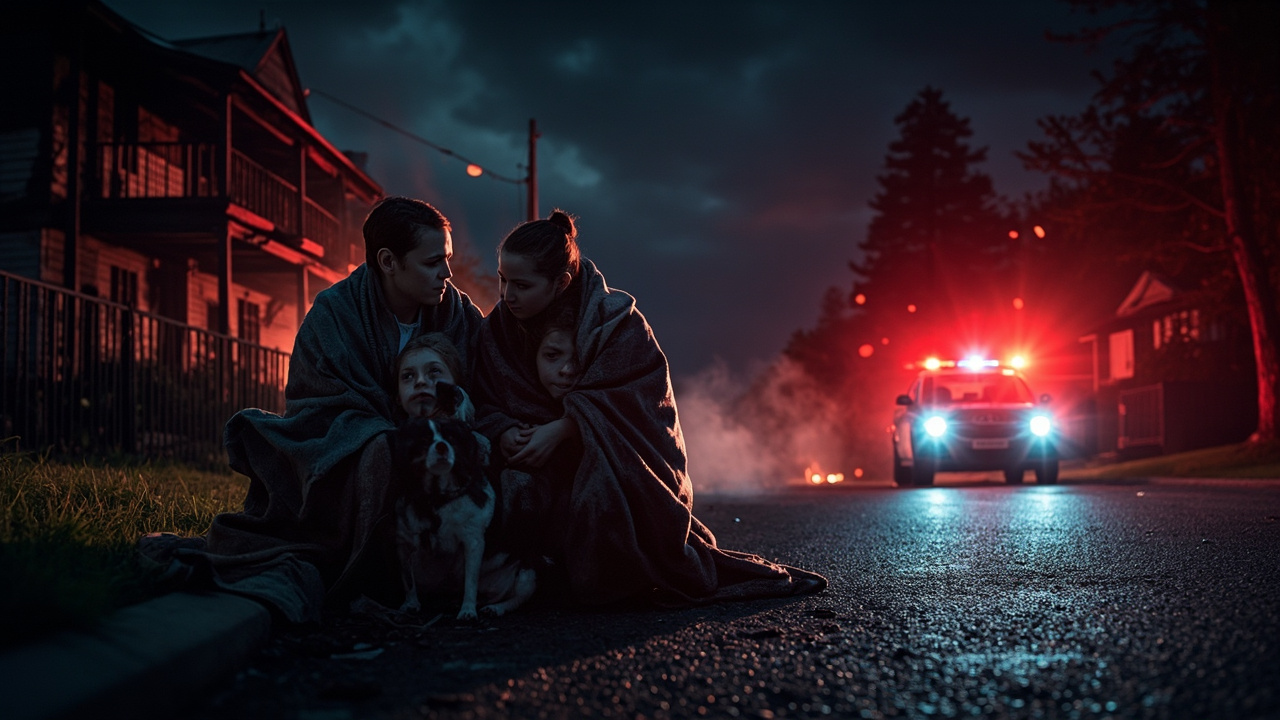
TL;DR: A New South Wales mother and two teenagers escaped a 1:30 a.m. house fire on September 18 with only the clothes they wore, a phone and a dog — showing why a packed go-bag must sit by the door.
A midnight knock that saved three lives and a dog
The newest verified fact in this archive week is stark. At about 1:30 a.m. on Friday, September 18, a two-storey home at Brooks Reach near Horsley erupted in flames while a family slept inside, according to the Illawarra Mercury.
Single mother Katie Kitchen was asleep with her children Zane, 16, and Zahli, 14. The family dog Bonni was sleeping in Zahli's room.
Kitchen did not wake to a smoke alarm in the reporting. She woke to pounding on the front door and shouting from a neighbour she had never met, Adrian Lamacchia.
"I was actually petrified hearing the banging on the door, and it took me a few minutes to process and get up out of bed," Kitchen told the Illawarra Mercury. "As soon as I got out of bed, that's when I saw the flames."
The fire was burning on the lower level of the two-storey home, directly underneath where the children were sleeping. Kitchen said she went immediately upstairs, opened bedroom doors and yelled for the children to get out because the house was on fire.
"I can't even recall my thoughts. I just went into action to get the kids and the dog out of the house," she said in the Illawarra Mercury account.
The three people and Bonni reached the driveway. Kitchen handed the children her phone and told them to ring emergency services. Her car keys were near the front door, so she ran back to grab them, got everyone into the car, drove around the corner and called for help while watching the house burn.
"It was horrible," she said.
A week later, Kitchen said the sequence remained a blur driven by adrenaline. The family has not been able to re-enter to assess salvage because sections of the home are at risk of collapse.
"We've lost absolutely everything," Kitchen told the Illawarra Mercury.
For bug-out bag readers, the loadout detail matters more than the property loss. They fled with nothing but the clothes they were wearing, one phone and the dog. No documents, no medications, no water, no chargers, no change of clothes and no pre-packed bag are described in the reporting. The only ready-to-grab item that worked was car keys kept near the front door.
That single staging choice — keys by the exit — allowed a vehicle evacuation when seconds counted.
What investigators and the community reported next
The cause of the Brooks Reach blaze remains under investigation, with crews working to determine whether the fire started inside or outside the house, according to the Illawarra Mercury. Police asked anyone with information to call Crime Stoppers on 1800 333 000.
The home is insured, but Kitchen told the paper she did not know whether the sum insured would cover the rebuild cost.
The children's school community and the Shellharbour City Basketball Association, known as the Shellharbour Bulls, rallied after the fire. The family is deeply involved in the club: Zane is a representative player, Zahli plays and referees, and Kitchen coaches.
Club administrator Amy Woodward created a GoFundMe page and club members donated. By Sunday, two days after the Friday fire, the club had outfitted Zane and Zahli with new basketball uniforms and boots so they could play that day.
"Everybody is devastated for them, devastated," Woodward told the Illawarra Mercury.
The speed of that community replacement effort underscores a preparedness point. Outside help replaced sports kit within 48 hours. It could not replace identification, medications, documents or overnight essentials in the first night after the fire. Those are precisely the categories emergency managers say belong in a household go-bag.
Kitchen also credited Lamacchia directly, saying she remained grateful for his quick thinking because the outcome could have been completely different. The reporting notes the young family had never met him before he saved their lives.
A second Australian fire story with the opposite decision
A separate evacuation account published September 28 by the Bendigo Advertiser shows what happens when residents do not leave early.
Brian Nunn had lived in Harcourt in central Victoria for more than 30 years. When fire that began in Ravenswood South spread to Harcourt on Friday, January 9, 2026, he refused to evacuate, according to the Bendigo Advertiser.
His actions helped save five houses and a kindergarten. More than 50 houses and buildings were destroyed in Harcourt, including the cool store, in the same fire.
Nunn later described lingering flashbacks, especially about what he saw near the cool store, seeing flames going up the road and how high they were. He told the paper he tries to focus on survival.
"I just soak it up and move on. I'm alive, that's the main thing, you know, that's all that matters," he said.
The tourist railway in Harcourt was also saved by firefighters. Secretary and treasurer of the Victorian Miniature Railway Karen Mierisch told the Bendigo Advertiser the attraction had taken 10 years to build and had only opened in December 2025.
"We just couldn't bear that after 10 years anything could possibly touch the railway, not after all the effort that the members have put in," Mierisch said. She thanked firefighters for saving a decade of work.
The critical loadout lesson comes from Nunn's changed plan. Despite staying in January, he told the paper he would leave if a similar event happened again.
"If it comes again, I'd go. I wouldn't hang around," Nunn said.
He said his reason for staying was that he did not think the fire would reach that far into Harcourt. He added that it was not worth risking a life and urged property owners to keep small properties tidy, mow grass and prevent vegetation reaching a metre high, including along roadsides.
The Bendigo Advertiser report also noted the Bureau of Meteorology had predicted an El Nino summer with drier and hotter conditions expected in Victoria.
For U.S. bag builders, the parallel is direct. A defend-in-place decision requires a defendable property, equipment, fitness and experience. Nunn's retrospective go-early conclusion matches the standard Australian fire-service message repeated across states: if in doubt, leave early.
What evacuees carried when boats replaced roads
A third account revisited during this news week shows an even more austere evacuation, where a vehicle bag would not have helped because roads were cut.
According to realestate.com.au, reporting on September 28 and citing ABC interviews, Fiona Logge was four months pregnant in December 2019 when the Currowan State Forest fire cut off the family's holiday home at Manyana on the New South Wales south coast.
The family was offered places on a passing boat packed with residents heading to a recovery centre in Ulladulla. They evacuated through the surf. During the escape, Logge watched her husband, architect Adriano Pupilli, jump back into the water and swim toward shore to try to save the home while others on the boat yelled for him to come back.
Days later the family returned to find fire had come within metres of the property line but left the home standing.
That story produced an announcement relevant to shelter and resupply. Pupilli designed Casa Manyana, a flatpack, fire-resistant tiny home intended as temporary emergency accommodation for people rebuilding in fire-prone communities, according to realestate.com.au.
The compact dwelling includes a bathroom, kitchenette and loft bedroom. It is constructed to BAL 40, the second-highest bushfire attack level rating, meaning it is designed to endure high levels of ember attack and near-direct exposure to flames.
Its frame fits in the tray of a ute, can be assembled in a single day and can be fully built in as little as two weeks, Pupilli estimates. Under New South Wales planning laws, a development application is not required for temporary emergency accommodation projects on residential land for up to two years. The project was nominated for two Australian architecture awards and priced from $75,000 to $120,000, aimed between emergency shelter and a full rebuild.
Logge told the ABC she already felt relief with the prototype near the family home as hot days returned, describing moving items from the house into Casa Manyana for protection.
This is an announcement of a design and housing option, not a completed government shelter-policy change. No future deployment date or government adoption is stated in the reporting.
What to pack so you do not flee in sleep clothes
The same September 28 realestate.com.au report carried direct household readiness guidance from Salvation Army Emergency Services national response manager Bindy Lupis. She urged households not to wait until an emergency is unfolding to work out what they need.
Lupis urged households to prepare a "go bag" with identification, important documents, medications, water, chargers, children's essentials and non-perishable food. Her stated planning window was what a household cannot live without for 48 hours to 72 hours.
She also urged Australians to check on elderly and vulnerable neighbours ahead of extreme weather.
That list maps exactly onto the gaps in the Brooks Reach escape. The Kitchen family had a phone but no reported documents, medications, water, chargers, children's spares or food when they stood in the driveway. The Harcourt and Manyana accounts likewise show no pre-packed kit playing a role; survival depended on neighbours, firefighters, a boat crew and a car with enough fuel to reach safety.
Meteorologist Tony Auden, cited in the same report via 7NEWS and Sunrise, warned bushfire danger was already building across parts of New South Wales, Queensland and Tasmania. He said to expect dry and worsening fire conditions in New South Wales and Queensland for the next two to three months, with rising risk later for southern New South Wales, Victoria, Tasmania and South Australia as hot, dry conditions deepened.
"Be on alert. Watch out for those warnings and prepare the household and yard early," Auden said. "Be prepared and you'll be best placed."
For a practical U.S. bug-out loadout, the consequence is narrow and concrete:
Keep vehicle keys, wallet identification and a 48- to 72-hour go-bag together near the exit you would use at night. Include copies of documents, daily medications, water, phone chargers, children's necessities, pet restraint and food, plus non-perishable food. The Brooks Reach family proved keys by the door can save lives. The same night proved clothes-only evacuation leaves every other first-night need to charity, insurers or stores.
Do not treat staying to defend as a bag substitute. The Harcourt resident who stayed and helped save buildings now says he would evacuate next time. The Manyana family survived because they accepted a boat seat when roads closed.
Pack to leave early, stage to grab in the dark, and keep fuel, cash and communications redundant before smoke appears.
Sources referenced
- Brooks Reach mum and kids flee house fire, but lose everything | Illawarra Mercury (https://www.illawarramercury.com.au/story/9358629/brooks-reach-mum-and-kids-flee-house-fire-but-lose-everything/)
- Harcourt bushfire hero Brian Nunn reveals lingering trauma | Bendigo Advertiser (https://www.bendigoadvertiser.com.au/story/9356914/harcourt-bushfire-hero-brian-nunn-reveals-lingering-trauma/)