TL;DR: Alaska emergency officials say western Alaska households should build a two-week home kit and a ready go-bag before fall storms arrive, as forecasters warn any season can bring high-impact flooding and outages.
On August 31, 2026, KNOM Radio Mission in Nome published new storm-season guidance from the Alaska Division of Homeland Security and Emergency Management, urging residents to prepare long before a storm appears in the forecast. The report, by Margaret Sutherland, centers on an interview with Public Information Officer Jeremy Zidek about water, food, heat, evacuation bags, documents and household plans. Days earlier, on August 26, 2026, KYUK in Bethel published a separate fall-storm forecast explainer by Samantha Watson with University of Alaska Fairbanks climate specialist Rick Thoman, warning that track changes and higher water levels can make even an ordinary storm damaging.
Together, the two reports define the loadout problem for this coastline: you may need to shelter without stores, power or running water for up to two weeks, or leave quickly for higher ground or a shelter that may not accept pets.
Why two weeks is the planning figure
Western Alaska fall storms can bring power failures, flooding and days without running water or other services, according to KNOM Radio Mission. Zidek said the state agency treats a home emergency kit as one of the central steps in personal readiness.
The agency's benchmark is self-sufficiency for as long as two weeks when roads, shops, electricity and other services are cut off. That figure shapes every quantity that follows, from drinking water to pantry food to heating fuel.
The timing message is explicit: act while skies are clear. State officials said preparation should start well ahead of any forecast, because storm behavior is unpredictable, according to KNOM Radio Mission.
Thoman offered a parallel warning from the climate side, as reported by KYUK. He said forecasts and storm tracks can shift quickly, using ex-typhoon Halong as proof, and advised checking again even if a forecast was reviewed two days earlier.
Water first, in food-safe containers
Emergency water ranks among the first needs when basic services stop, Zidek said, according to KNOM Radio Mission.
His practical step is simple: obtain food-safe containers and fill them as a storm approaches to create a reserve. The agency guideline cited in the report is one gallon per person per day. Applied to a household of five over fourteen days, that math reaches 70 gallons.
The same report acknowledges that volume may not be practical in every home. Zidek said families should nevertheless store as much as they possibly can.
For a bug-out bag and home cache, the implication is layered storage. A portable bottle and filter-style carry covers movement, while larger sealed containers staged high and indoors cover shelter-in-place days when taps fail.
Food that survives outages and floodwater
The second priority is a two-week reserve of easy-to-prepare pantry and freezer food, after taking inventory of what is already on hand, according to KNOM Radio Mission.
Zidek noted that many households engaged in hunting and gathering already approach that level because they provision for winter. The added task is protection, not just quantity.
A long electrical outage can spoil frozen food. Floodwater can ruin packaged stores or carry them away entirely. To counter those risks, the report lists two concrete actions: keep two weeks of backup fuel to power a freezer with a generator, and lift stored food above expected flood height where possible.
For pack planning, that points to separating everyday food from storm food. Keep grab-and-go calories in the bag, and keep bulk reserves sealed, elevated and Rotated separately from daily use.
Heat that lets you stay home safely
The third priority is a safe indoor backup heat source plus fuel to run it, such as a woodstove or portable propane heater with adequate firewood or fuel oil, according to KNOM Radio Mission.
“When you have food, water, and those fuel sources, you can stay in your home,” Zidek said. “And that’s really the best place for folks during these disaster situations.”
Staying home avoids dangerous travel and crowded shelters when conditions allow, but only if warmth can be maintained without creating a new hazard. The report specifically warns against candles during outages, saying they give limited light and can start fires.
A loadout lesson follows: pack headlamps, lanterns and extra batteries instead of open flame for light, and treat heating as a home system rather than a backpack item.
What goes in the go-bag
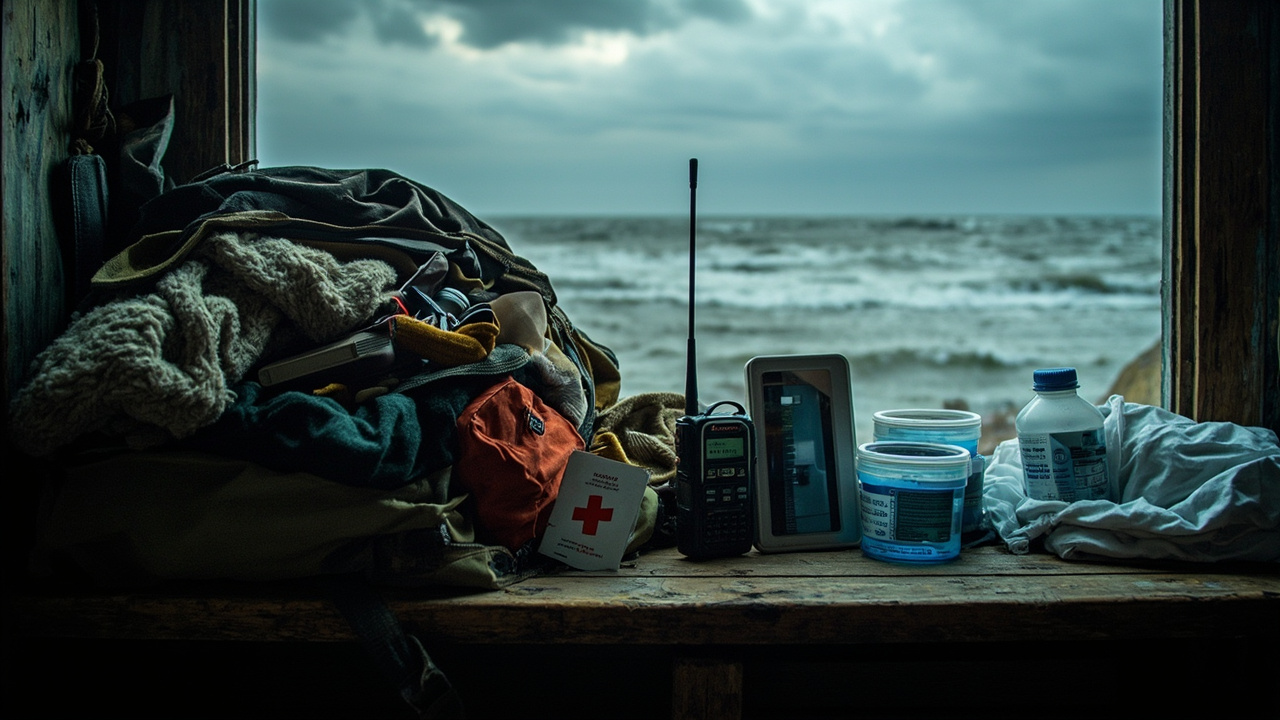
Beyond the home kit, Zidek recommends a packed bag that works either for evacuation or for sheltering in place, according to KNOM Radio Mission. The listed contents are warm clothes, a flashlight, headlamp or lantern with extra batteries, a first-aid kit, a basic tool kit, toiletries and cleaning supplies, a bucket with bags for sanitation, over-the-counter drugs plus extra prescription medicine, spare eyeglasses, a battery-powered or NOAA weather radio, a cell phone charger, and backup batteries or a power bank.
Each item maps to a failure seen in past coastal storms. Warm clothes and sanitation supplies cover displacement and plumbing loss. Lighting, radio and power cover grid loss and loss of local phone service. Medications and eyeglasses cover extended separation from clinics and stores.
Pet owners need a second kit with food, water, medications, vaccination records and comfort items. The report also notes that some shelters may not be able to take pets, making advance transport planning part of the bag plan rather than an afterthought.
Documents, fuel tanks and vehicles
Recovery paperwork is presented as gear, not bureaucracy. KNOM Radio Mission reports that residents should gather passports, driver’s licenses, birth certificates and proof of home ownership or occupancy, then store them high and where they can be reached quickly.
Zidek explained that state and federal recovery programs require extensive proof of identity and ownership, and that a ready folder can speed recovery after damage.
Home protection steps focus on floating and washout risks. Outdoor fuel tanks should be secured on solid footings to a house or other sturdy support so they do not topple or float away in floodwater. As a storm nears, vehicles should be moved away from beaches and riverbanks to higher ground where available.
For a practical loadout, that means waterproofing the document folder inside the go-bag, and staging the bag itself above likely water entry rather than by a low doorway.
Written plan and local leave decision
Written household plans do not need to be elaborate, according to KNOM Radio Mission. Zidek suggested starting with paper and pen, recording where to go, who cares for elders and minors, and naming an out-of-community contact in another town or state to call if local service fails.
That outside contact matters when local towers and lines are down but long-distance paths still work for some callers. Naming caretakers in advance avoids confusion during a night evacuation.
There is no single statewide rule for shelter-in-place versus evacuation. Zidek said storms are unpredictable, can change track quickly and often force moment-by-moment choices. Decisions rest with each community, based on local ground truth that distant managers cannot always see.
He recommended discussing in advance what would trigger leaving, such as a certain water level, wind speed or official warning from local authorities. Talking through those thresholds with family and neighbors turns the go-bag from equipment into an executable plan.
Forecast context: any season needs readiness
The KYUK forecast report adds urgency without predicting a specific landfall. Thoman explained El Niño as warmer-than-normal water in a patch of equatorial Pacific about 1,000 miles southeast of Hawaii, by only a degree or two, yet enough to shift where large tropical thunderstorms form.
Looking at six El Niño seasons in the past 55 years, he found no correlation with the count of strong Bering Sea storms, but a tendency toward more Western Pacific typhoons, the basin where Typhoon Halong developed. More typhoons create more chances for the remaining ingredients to align toward Alaska, though he said that does not mean an impact will happen.
Thoman said an extreme event on the scale of Typhoon Halong or Typhoon Merbok remains very unlikely, while stressing both were record-breaking storms in regular, non-El Niño years. Fall storm frequency has not changed, but winter storms in the Bering Sea region have trended upward over 60 years, and impacts have grown because of higher sea levels, less sea ice in the region and sinking land from thawing permafrost in the Yukon-Kuskokwim Delta.
His bottom line, as quoted by KYUK, was direct: “For any fall season in Western Alaska, we need to be prepared.” For bag owners, that means packing for consequences — water, cold, darkness and displacement — rather than waiting for a named storm.
Sources referenced
- Fall storm season is near, here are some ways to prepare - KNOM Radio Mission (https://knom.org/2026/08/31/fall-storm-season-is-near-here-are-some-ways-to-prepare/)
- What to know about this year's fall storm forecast - KYUK (https://www.kyuk.org/science-and-environment/2026-08-26/what-to-know-about-this-years-fall-storm-forecast)