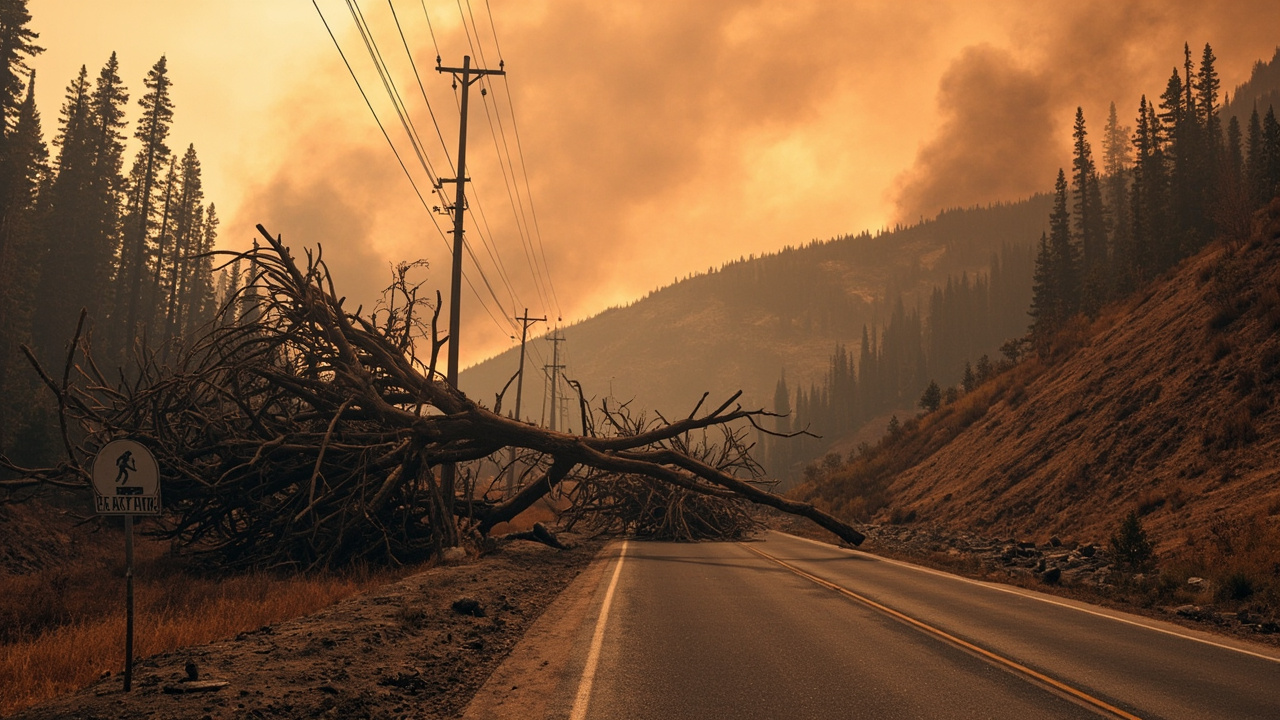
TL;DR: Colorado investigators found a wind-toppled aspen tree hitting energized power lines started the 102,000-acre Aspen Acres fire on June 29.
State investigators have closed the origin question on one of Colorado's largest and most destructive wildfires of 2026. According to The Colorado Sun, a 46-page report from the Colorado Division of Fire Prevention and Control concludes an aspen tree brought down by strong wind contacted energized conductors and ignited the Aspen Acres fire about 200 feet west of Colorado Highway 165 in Custer County.
The report was released Tuesday, Oct. 13, and places the start shortly before the fire was reported at about 5:39 a.m. on June 29 near mile marker 17, according to The Colorado Sun. According to Colorado Public Radio (CPR News), division investigator Josh Dreher wrote the investigation and located the specific area of origin just south of the Aspen Acres Campground.
Where investigators say the fire began
Investigators describe a tree failure during a high-wind event at the end of June, according to CPR News. Strong winds uprooted the aspen and dropped it onto overhead lines, according to The Colorado Sun.
The weight of the fallen tree pulled the conductors to within a few feet of the ground, according to CPR News. The Colorado Sun reported the lines were hanging about 3 feet above the ground after the contact. The surrounding ground cover included grass, brush and trees.
Investigators who reached the origin area on July 15 documented charring and burn marks on the aspen trunk where it touched electrical conductors, according to The Colorado Sun. The report identifies contact with both the hot and neutral conductors, and describes arcing, melting and charring on the conductors themselves.
According to Denver7 reporting carried by KOAA, melted aluminum was found beneath the point where the tree rested against the line. That outlet reported investigators viewed the melted metal as a contributor to ignition. The same reporting said heat from the lines raised the bark and nearby vegetation to ignition point.
What the burn patterns and witnesses showed
Fire-pattern indicators showed the blaze moved away from the origin and burned more intensely as it left the starting point, according to Denver7/KOAA. The Colorado Sun reported flames immediately ran west up a hill and to the south, then pushed east across Colorado 165 and also spread west and northwest.
One resident told investigators lights flickered on and off around 5:30 a.m. on the morning of the fire and that smoke could be smelled outside a home south of the Aspen Acres Campground, according to The Colorado Sun. Another resident photographed an aspen leaning beside an electrical pole near the highway.
Denver7/KOAA reported a local resident witnessed the ignition at 5:45 a.m. on June 29 in the vicinity of utility poles. That account described immediate westward and southward spread up the hill.
According to KRDO, the origin was southwest of the intersection of Highway 165 and Custer Drive. KRDO reported investigators included dozens of photographs showing downed trees, power lines and burned material.
When investigators arrived at the origin on July 15, several San Isabel Electric Association vehicles were parked in the area, according to The Colorado Sun. San Isabel owns the power lines involved, according to KRDO.
What investigators ruled out
Officials had described the fire as human-caused, meaning it was not started by lightning or a similar natural event, according to KRDO. The final report eliminates three other possible ignition sources.
Investigators ruled out lightning, smoking materials and arson, according to The Colorado Sun. KRDO reported division data confirmed no lightning strikes in the area at the time the fire started.
Denver7/KOAA reported more detail on that exclusion. A five-mile STRIKEnet review found zero cloud-to-ground strikes detected by lightning sensors within five miles of the origin area. No physical evidence of a strike was found, and no one reported lightning that day.
No smoking materials were recovered in the area, according to Denver7/KOAA. Investigators determined a smoking-material ignition was inconsistent and not viable given data collected during the investigation.
Intentionally set fires, as defined in the report, are not limited to arson and can include open flames such as candles, matches, lighters, pilot lights and oil lamps, according to Denver7/KOAA. Investigators found the fire did not begin near structures with such open flames.
Scale of the evacuation fire
The Aspen Acres fire grew to more than 102,000 acres across Pueblo, Custer, Fremont and Huerfano counties, according to The Colorado Sun. The U.S. Forest Service listed 102,007 acres as of Oct. 2, according to Denver7/KOAA. KRDO reported just over 102,000 acres with 82% containment as of Aug. 13.
Containment remained at 82% on Tuesday, Oct. 13, with fire still active in remote areas, according to The Colorado Sun. CPR News reported the blaze was still smoldering more than 100 days after it started. KRDO noted members of the Rye Fire Protection District were first dispatched to a fire near the Aspen Acres campground more than 100 days earlier.
The human toll was severe. At least 850 structures were destroyed in Pueblo and Custer counties, according to The Colorado Sun. CPR News reported more than 900 buildings destroyed and said at least 340 of the destroyed structures were homes. Denver7/KOAA reported more than 200 homes destroyed and thousands of people evacuated across the four-county fire footprint.
County-level damage details were reported by KRDO, citing the Alaska Incident Management Team estimate of around 850 structures lost. That station reported at least 241 homes or commercial properties in Pueblo County, including 208 in Beulah, 28 in Rye, 2 in Colorado City and 3 in unincorporated areas. The Custer County sheriff reported at least 85 homes lost in that county.
The fire followed a winter of record-low snowfall and extreme drought, with little rain through summer, according to The Colorado Sun. Hundreds of firefighters and other personnel from across the country assisted in the response.
Wind was central both to ignition and spread. KRDO reported wind speeds around the time of ignition reached up to 50 mph. The Colorado Sun quoted the report stating wind was a contributing factor in rapid spread.
Monsoonal rains in August aided firefighters in some areas but also caused catastrophic flooding and mudslides in Beulah, according to The Colorado Sun. An 80-year-old man was killed in that flooding.
Lawsuits and utility response
At least five lawsuits filed by fire survivors accuse San Isabel Electric Association, a rural electric cooperative, of igniting the fire, according to The Colorado Sun. Some suits allege the cooperative failed to clear vegetation around power lines despite known wildfire risk.
CPR News reported the initial ignition finding is largely similar to allegations in several lawsuits against San Isabel. That outlet also reported the state investigation does not determine liability for the cause.
KRDO quoted a Beulah resident, Kris Allen, saying wind, trees, dry conditions and drought made such a tree-down ignition unsurprising. San Isabel told KRDO its focus remains on supporting affected families and continuing service to members, adding it could not comment on matters in pending litigation.
CPR News reported San Isabel previously said its focus was repairs and restoring service, without further comment.
What it means for a bug-out loadout
For households near timber and overhead lines, this was a no-notice early-morning evacuation fire. Flames moved uphill immediately after ignition, crossed a highway, and later forced thousands to leave across four counties.
Keep a go-bag packed so departure is not delayed during flickering power, smoke odor, or fast-moving flames. Store copies of essential papers where they can be grabbed quickly.
Plan for a long displacement. With hundreds of homes destroyed and containment work extending beyond 100 days, returning home was not a same-day event. Include extra medication, chargers, cash, and clothing for several days away.
Expect follow-on hazards after the flames. Flooding and mudslides struck Beulah after August rains, killing one resident. Pack rain protection and sturdy footwear even during wildfire season, and avoid burned slopes and drainages when storms arrive.
Sources referenced
- Tree falling on power line sparked Aspen Acres fire, report says - The Colorado Sun (https://coloradosun.com/2026/10/13/aspen-acres-investigation-report/)
- State investigation concludes Aspen Acres fire was started by a tree falling on power line - Colorado Public Radio (https://www.cpr.org/2026/10/13/aspen-acres-state-investigation-tree-falling-power-line/)