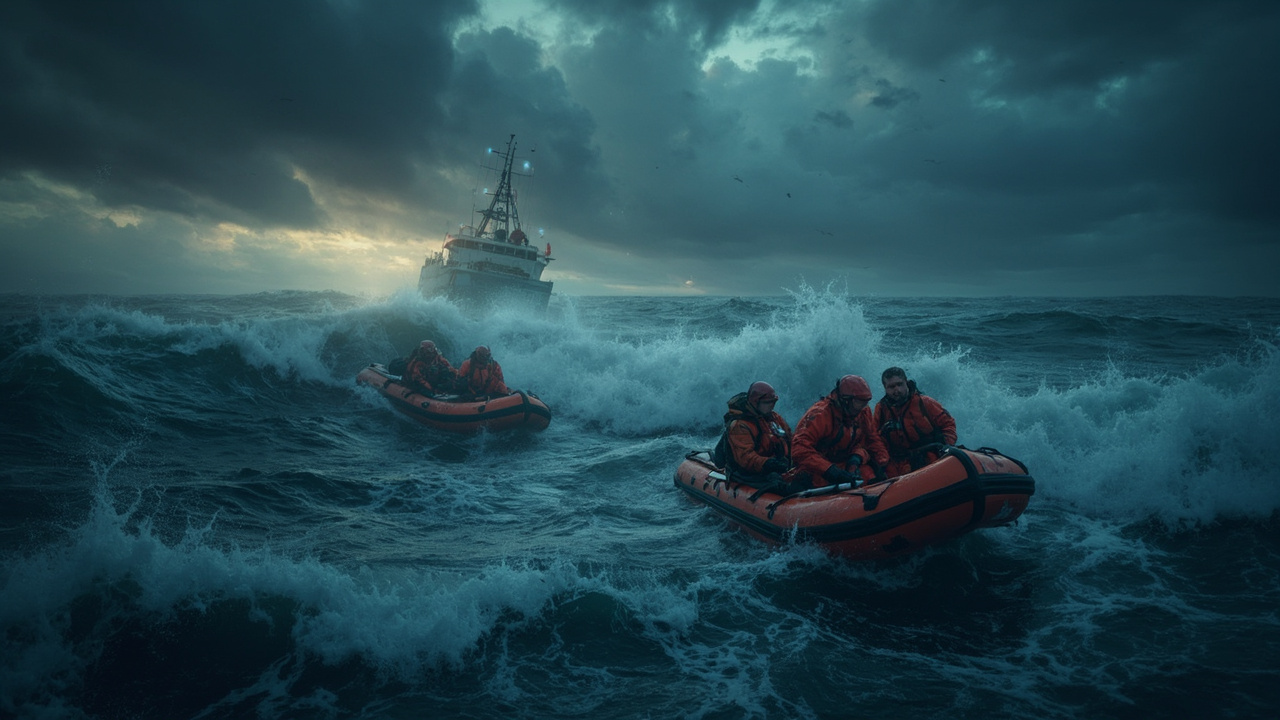
TL;DR: The UK investigation published 25 September 2026 found an unsecured side hatch flooded the fishing vessel Argos Georgia in 2024, and survival depended on immersion suits, intact liferafts and a fast Mayday.
Final report closes two-year inquiry
The sinking was classified as a very serious marine casualty and examined in Accident Investigation Report 19/2026, according to the GOV.UK page titled Foundering of the fishing vessel Argos Georgia with the loss of 13 lives.
The vessel was a St Helena-registered longliner on passage from Port Stanley in the Falkland Islands toward fishing grounds near South Georgia, that page states.
The date of occurrence was 22 July 2024, with the location given as approximately 190 nautical miles east of Port Stanley.
Of 27 people on board, 13 lost their lives and 14 survived, the investigation summary records.
The inquiry was carried out by the UK Marine Accident Investigation Branch on behalf of the St Helena Government under the Category 2 Red Ensign Group Memorandum of Understanding, according to the GOV.UK news notice titled Argos Georgia report and safety flyer published.
That notice confirms publication on 25 September 2026, alongside a separate safety flyer for the fishing industry.
Chief Inspector of Marine Accidents Rob Loder said fishing in remote and hostile waters demanded strict protection of watertight integrity, rapid execution of a clear emergency plan, and regular training and drills, that notice records.
How a single hatch started the flooding
The investigation found that a line-hauling hatch in the starboard side opened without command while the vessel was underway, the report summary states.
Substantial water then entered and the vessel developed a starboard list before foundering.
The manual securing arrangement for that hatch had likely not been engaged, and the crew were unable to shut the hatch after it moved, the summary states.
Investigators also identified an unidentified weakness in the hatch drive mechanism, according to that same summary.
The hatch had opened unexpectedly on an earlier occasion and its drive had been modified, according to the GOV.UK page titled Safety flyer to the fishing industry – Argos Georgia.
That flyer urges operators to obtain design approval before making changes that could materially affect vessel safety.
For a bug-out or abandon-ship bag, the lesson is structural before it is packing: no ditch kit compensates for a hull opening left without its mechanical lock.
Open interior doors let water spread
Flooding did not remain in the line-hauler compartment.
Water moved through main-deck spaces because internal weathertight doors had been left open, the safety flyer states.
Floodwater probably damaged remote-closure systems for those doors and hindered manual attempts to close them, the flyer states.
Leaving those doors open had become routine practice, even though the vessel's stability information booklet required them to remain closed at sea, the flyer states.
External reviewers cited by gCaptain in the article titled Hatch Failure Triggered Deadly Fishing Vessel Sinking That Killed 13, MAIB Finds similarly reported that water spread from the line-hauling room into adjacent areas and produced an uncontrollable list.
The report summary separately lists open weathertight doors, vulnerable electrical installations and inaccessible manual controls as factors that allowed progressive flooding.
The practical loadout point is procedural: a survival bag must include a door-and-hatch routine, with assigned checks that shell openings and interior watertight boundaries are actually secured before heavy weather.
Distress call came late
The crew first sought assistance through informal channels.
Crew members messaged contacts on other longline vessels through WhatsApp to request help, the safety flyer states.
The general alarm was then sounded and personnel gathered on the bridge to put on immersion suits, the flyer states.
The maritime search-and-rescue authority in the Falklands learned of the WhatsApp traffic and the developing emergency but had not received a Mayday, the flyer states.
By 1530 the vessel operator told the rescue authority that distress was being declared and abandonment was being prepared, the flyer states.
By 1600 the list had reached about 60 to 70 degrees, power had been lost, and a sister ship transmitted a Mayday Relay on behalf of Argos Georgia, the flyer states.
The safety flyer states that reliance on informal messages postponed the rescue response by about two hours and directs mariners never to hesitate in sending a Mayday.
The gCaptain report likewise notes investigators found unstructured onboard reaction and delay in declaring distress and leaving the vessel reduced available rescue time.
For personal gear, that sequence argues for immediate access to registered distress equipment rather than dependence on a phone chat: a deck-ready waterproof VHF with distress calling, a personal locator beacon on the body, and an emergency position-indicating radio beacon mounted to float free.
Abandonment in darkness and heavy weather
The captain subsequently ordered abandonment, the flyer states.
The starboard liferaft released automatically because of the angle of heel, while the port raft was launched by crew, the flyer states.
Two people were lost while trying to swim to and board a raft, the flyer states.
Thirteen people initially entered one raft, but several buoyancy tubes were punctured when that raft was brought nearer the ship, the flyer states.
Those occupants transferred to the second raft, which then drifted away, while six others boarded the damaged raft and also drifted away, the flyer states.
Four people remained on the sinking vessel, the flyer states.
Rescue aircraft reached the scene after dark, located and tracked both rafts, and a helicopter attempted to recover a person seen floating face down, the flyer states.
That attempt failed because of severe conditions and only ten minutes of available time overhead, the flyer states.
The vessel capsized and sank at 1900, the flyer states.
The episode shows why a grab bag should protect raft capacity: keep knives, hooks, broken fittings and sharp deck gear away from inflated tubes, carry patches and a pump only where supplied for that raft type, and keep suits, hoods, gloves and strobes ready before muster rather than stored below a flooding deck.
Rescue at first light
The first rescue vessels arrived at about 0530 the following morning and reported winds of 75 knots with a seven- to eight-metre swell, the flyer states.
Additional vessels arrived during the following hours, the flyer states.
One survivor was recovered alive from the damaged raft, all thirteen occupants of the intact raft were recovered alive, and nine deceased crew were recovered from the water, the flyer states.
Four people remained missing and were presumed dead, accounting for the total of thirteen deaths alongside fourteen survivors from twenty-seven aboard, the flyer states.
The investigation summary links prolonged cold-water exposure, evacuation difficulties, severe conditions and raft damage to the loss of life.
The safety flyer directs crews to drill for flooding, including practice in closing watertight flaps and ventilation dampers to gain time.
A practical bag therefore centers on cold-water survival: a correctly sized immersion suit with sealed closures, thermal layers that function when damp, a hood and mitts, a whistle and light for night detection, and seasickness medication retained where abandonment drills place it, to the extent those items are carried in personal issue and vessel stores.
What regulators and owners were asked to change
The investigation made three formal recommendations, the report summary states.
The Maritime and Coastguard Agency was recommended to revise Merchant Shipping Notice 1873 (F), covering construction and safe operation of fishing vessels of 24 metres registered length and over, to set design rules for shell-door arrangements that at minimum demand automatic locking capable of holding doors shut, that summary states.
Argos Froyanes Limited was recommended to introduce a documented safety-management system across its fishing vessels, that summary states.
The Falkland Islands Government, Directorate of Emergency Services and Islands Security was recommended to strengthen maritime search-and-rescue communications so direct and reliable contact can be established with vessels in distress inside the Falklands rescue area, that summary states.
The report summary also records shoreside weaknesses in controlling safety-critical risks and in assessing, escalating and answering flooding, abandonment and distress emergencies in severe and remote conditions.
Those are announcements of requested future action, not findings that the changes have already been completed.
For private planners and small crews, the parallel is to write down the same three things: hull-closure standards, a one-page flood and abandonment drill, and a communications plan that lists who calls Mayday, on which equipment, and when.
Sources referenced
- Foundering of the fishing vessel Argos Georgia with the loss of 13 lives - GOV.UK (https://www.gov.uk/maib-reports/foundering-of-the-fishing-vessel-argos-georgia-with-the-loss-of-13-lives)