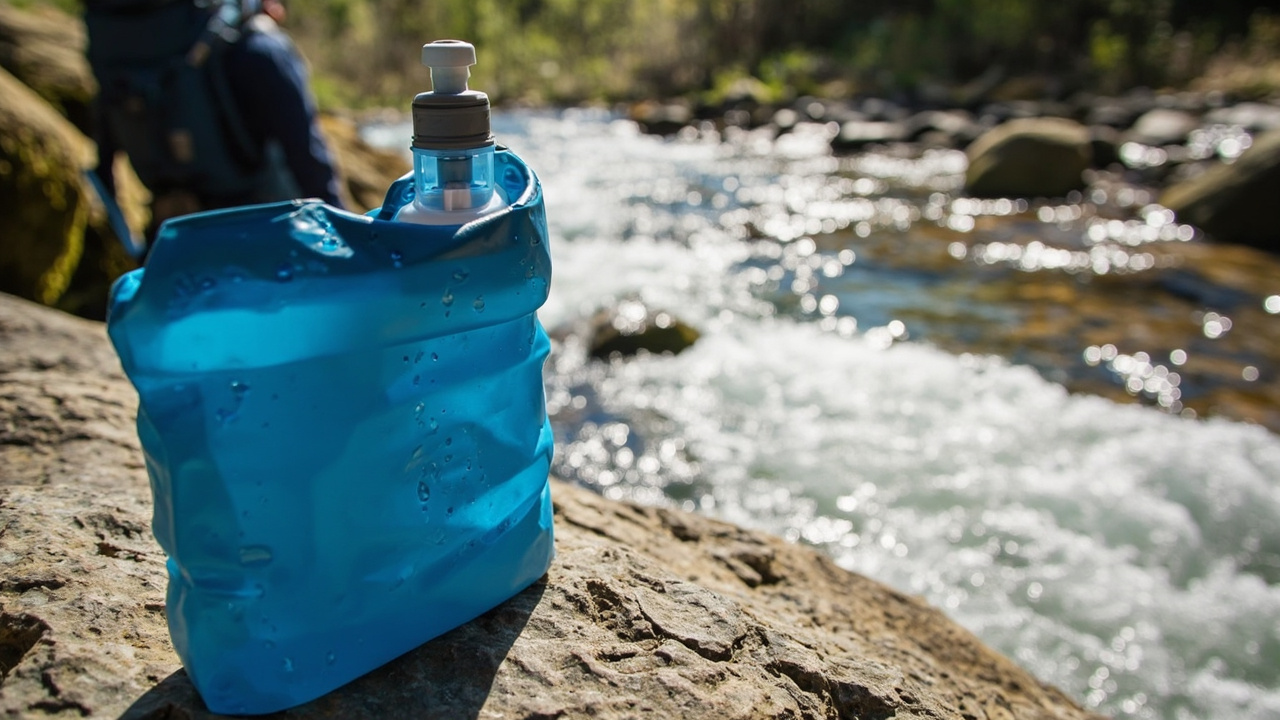
TL;DR: Two October 2026 independent tests rate the LifeStraw Peak Squeeze as a top personal squeeze filter for bug-out bags because it combines a 0.2-micron filter, collapsible bottle, and straw use in one $44 kit.
Newest verified result answers the loadout question
According to OutdoorGearLab, reviewer Trish Matheny published a test on October 12, 2026, giving the LifeStraw Peak Squeeze an overall score of 78 and ranking it No. 1 of 20 backpacking water filters as Best Overall Filter for Personal Use at a list price of $44.
According to AdventureKit, author Thomas updated a separate field test on October 9, 2026, giving the 650-ml Peak Squeeze a field-tested rating of 8.7/10 after paying $80 for the Mountain Blue version that weighed 102 g.
Both 2026 tests describe the same core system: a membrane microfilter with a 0.2-micron pore size in a collapsible soft bottle with a backflushing syringe in the box. Both conclude it removes bacteria, parasites and microplastics but does not filter viruses.
For a bug-out bag, that finding means one 102-g to 4.2-ounce kit can cover drinking directly, squeezing clean water into a cook pot, and sipping as a straw, while requiring space for the syringe and a plan for virus risk and frequent refills.
What the No. 1 ranking measured
OutdoorGearLab scored the Peak Squeeze across five weighted categories: Water Quality 30% at 7.5, Ease of Use 20% at 9.0, Durability & Maintenance 20% at 7.0, Treatment Time 15% at 8.0, and Weight & Packability 15% at 7.5.
The review lists reasons to buy as simple design, top-notch quality and durability, versatile filtration options and long filter life. It lists reasons to avoid as not the lightest squeeze-bottle system and a requirement for regular maintenance.
The verdict describes a hollow-core membrane and microfilter that protects against bacteria, protozoa and microplastics with a competitive flow rate of two liters per minute. The review says the system packs down to the size of a palm.
OutdoorGearLab reports test locations including day missions in California's High Sierra and an extended trip in the Cochamó Valley of Southern Chile. Testers also used the filter in the mineral-rich, sandstone waters of the Virgin River in Zion National Park.
What the 8.7/10 field test measured
AdventureKit breaks its 8.7/10 field-tested rating into Ease of Use at 86%, Performance at 90%, Portability at 98%, Durability at 84% and Value at 77% for the 650-ml bottle.
The review states the buyer gets a soft, collapsible 650-ml bottle, a filter that screws into the neck, and a cap with a loop that covers a soft mouthpiece. The box also includes a syringe for flushing the filter clean.
AdventureKit lists the 650-ml version at 10.4 × 25.4 cm and 102 g with the filter. It states the bottle comes in Mountain Blue and Dark Grey and in two sizes: 650 ml and 1 litre.
The review lists positives as filtration of bacteria, parasites and microplastics, 102-g weight, roll-up packability when empty, ability to squeeze filtered water into a pot or another bottle, straw use, compatibility with other Peak Series systems, flow up to 3 litres per minute, and a filter life up to 2,000 litres that stops flowing when spent.
The same review lists negatives as no virus filtration, no carbon filter for taste, 650 ml capacity described as not much for a full day, and hand-wash-only care.
Water quality and limits
OutdoorGearLab states the Peak Squeeze is a hollow-fiber water filter designed to protect against bacteria and protozoa while meeting the U.S. EPA and NSF P231 drinking water standards for removing bacteria and parasites.
The review cites manufacturer claims of physical removal of 99.999999% of bacteria such as Salmonella, cholera and E. coli, 99.999% of parasites, and 99.999% of microplastics. It also cites removal of silt, sand and cloudiness greater than 0.2 microns.
AdventureKit states the membrane microfilter has a pore size of 0.2 micron and, according to LifeStraw, protects against 99.999999% of bacteria such as E. coli and Salmonella, while also removing parasites, microplastics, silt, sand and cloudiness.
Both publications state the filter does not remove viruses because viruses are smaller than the pores. OutdoorGearLab notes third-party lab results commissioned through SGS Labs confirmed elimination of greater than 99.9% for bacteria, Giardia and Cryptosporidium and greater than 78.6% for viruses, while adding that LifeStraw does not claim virus elimination and recommending a filter designed for viruses for international travel.
AdventureKit notes the Peak Squeeze has no carbon filter, unlike the LifeStraw Go Series 2.0, so it does not address chlorine or bad taste. According to CleverHiker, the Peak Squeeze reduces chlorine to improve the taste of chemically treated water when paired with chemical treatment for questionable sources.
Flow, clogging and maintenance in the field
OutdoorGearLab found the filter prone to clogging after a couple liters in mineral-rich water sources. It reports decent performance in better-flowing sections of the Virgin River and a need for several backflushes after filtering thick water after heavy rain in the Cochamó Valley.
AdventureKit states the filter is rated for up to 2,000 litres and stops flowing at end of life so unfiltered water cannot be drunk by accident. It includes a syringe in the box for flushing the filter clean.
According to CleverHiker, author Brett Kretzer published a June 8, 2026 test after backpacking trips throughout the Rockies, filtering clear alpine streams to silty glacier-fed sources, plus controlled testing of flow rate, treatment time and durability.
CleverHiker lists a measured flow rate of 1.75 L/min, a pore size of 0.2 microns and a lifetime volume of 2,000 L at a price of $44. The review states filtration with the included soft flasks typically took 35 to 40 seconds per liter out of the box, while standard Smartwater-style bottles were closer to about a minute per liter and gravity alone took roughly 15 minutes for a liter.
CleverHiker states the filter tends to clog sooner than some competing models without diligent backflushing, but cleaning is simple and restores performance fairly well. OutdoorGearLab similarly states the system requires regular maintenance.
Versatility: five carry and drink modes
OutdoorGearLab describes three uses: use the filter as a straw to sip direct from a stream in shallow water, fill the soft bottle where flow is ample, and remove the filter and use the soft bottle as a vessel to carry water between dispersed sources.
AdventureKit describes five ways shown on the box: drink directly from the mouthpiece with the filter inside, fill other containers by squeezing filtered water into a pot, mug or another bottle, screw the filter on the outside of the bottle to get the last drop, use the filter as a straw on its own, and connect it to other Peak Series gravity systems.
AdventureKit adds that the filter can be removed and the bottle used only to carry water. OutdoorGearLab adds that the filter can be attached to another bottle for users who prefer something sturdier than the collapsible bottle, while noting the soft-bottle opening can be difficult to fill in shallow sources.
According to CleverHiker, the filter works with 28-millimeter bottles such as Smartwater bottles and larger 42-millimeter soft flasks, and can be adapted into a gravity system. The review states the included soft bottle is BPA-free with a wide 42-millimeter opening, a comfortable rubber mouthpiece and a screw-on cover that protects the drinking surface.
Weight, size and durability trade
OutdoorGearLab describes a thick and premium vessel material selected for consequential terrain and murky sources to reduce concern about rips and tears. It states the design is not the lightest squeeze system tested.
AdventureKit states the empty 650-ml bottle goes flat and rolls up for pack or door-pocket storage, while a rigid bottle occupies the same space full or empty. It states the cap loop accepts a carabiner for hanging from a pack, and the bottle has a max fill line near the top.
CleverHiker reports a minimum weight of 1.5 ounces using only 28-millimeter bottles, 2.4 ounces with the 42-millimeter mouthpiece as filter-only weight, and 4.2 ounces for the full kit with the one-liter LifeStraw bladder. The review states the filter housing is durable plastic that protects the internal microfiber filter, and the thicker soft flasks hold shape when full for side-pocket carry.
AdventureKit lists a 3-year warranty. CleverHiker gives a rating of 4.6/5.0 and calls the system Most Versatile Water Filter, citing ultralight weight, good flow and compatibility with bottles and bladders against cons of frequent cleaning and middling flow.
Practical bug-out bag consequence
For evacuation carry, the October tests support packing the 1-litre size where refills are uncertain because AdventureKit found 650 ml is small for a full day. The 1-litre soft bottle, filter and syringe described by OutdoorGearLab keeps drinking, transport and refilling Drink, carry and refill in one palm-size package.
Pack the included syringe because both October reviews and the June Rockies test tie continued flow to backflushing. In mineral-rich or post-rain water like the Virgin River and Cochamó Valley examples, testers needed one or several backflushes to restore flow.
Carry a spare 28-millimeter rigid bottle because CleverHiker confirms Smartwater-style compatibility and OutdoorGearLab confirms attachment to another bottle. That provides a sturdier squeeze vessel and a backup if the soft bottle is punctured.
Do not rely on the Peak Squeeze alone for virus protection or taste improvement because AdventureKit confirms no virus filtration and no carbon filter. CleverHiker reports pairing the filter with chemical treatment for questionable water, with chlorine-taste benefit.
Sources referenced
- LifeStraw Peak Squeeze Review | Tested & Rated - OutdoorGearLab (https://www.outdoorgearlab.com/reviews/camping-and-hiking/backpacking-water-filter/lifestraw-peak-squeeze)
- LifeStraw Peak Squeeze Review (650 ml Filter Bottle) | AdventureKit (https://adventurekit.com.au/lifestraw-peak-squeeze-review/)